14 - Unresolved objects
Jupiter and its four largest moons, too far away to cover a pixel: placed by ephemeris and drawn like stars, as seen from low Earth orbit on 2016-09-19. And how light time and aberration move them.
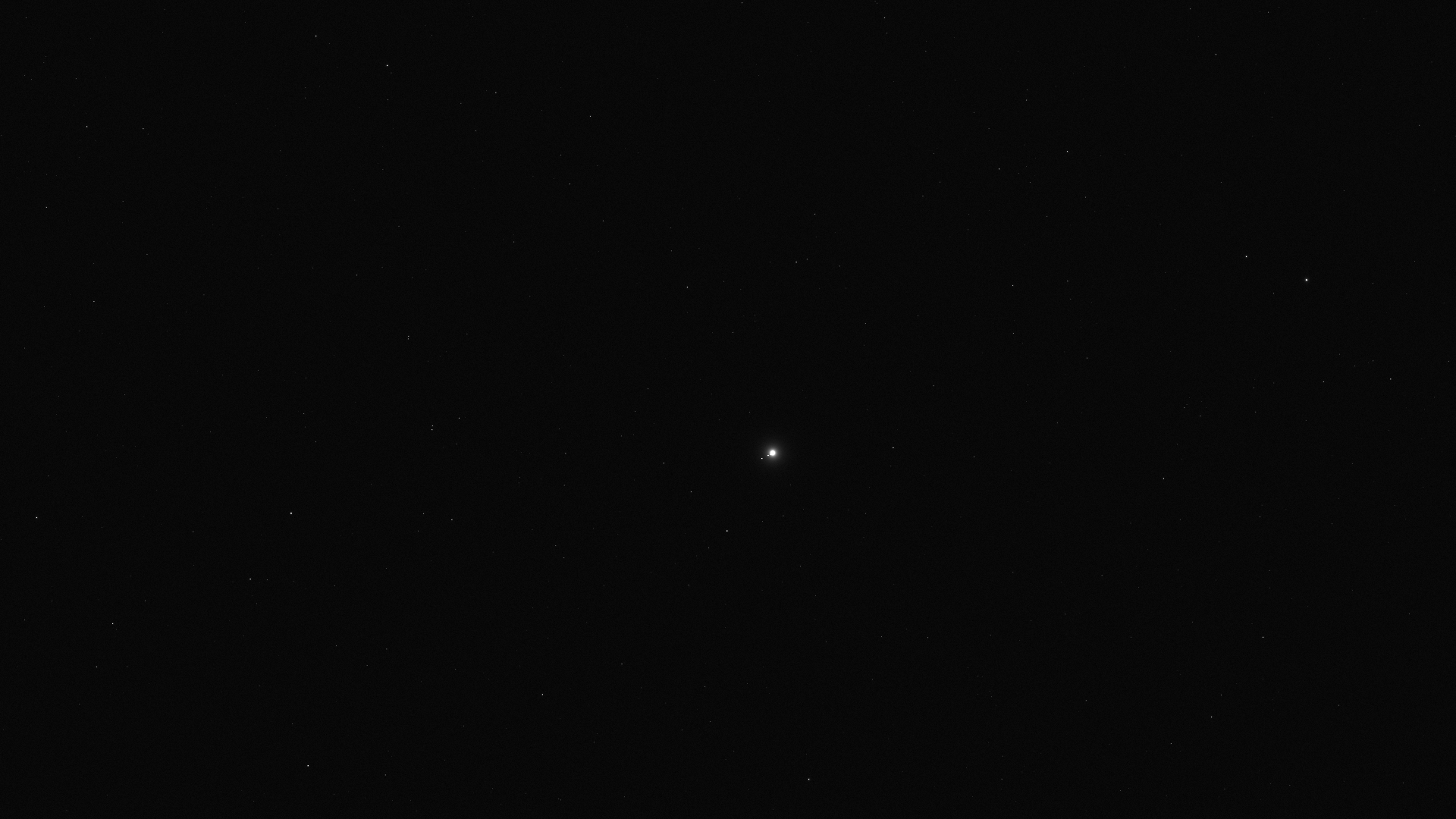
Data
File |
What it is |
From |
|---|---|---|
|
JPL’s planetary ephemeris DE440 (short version), an SPK |
|
|
JPL’s ephemeris of Jupiter and its moons, an SPK |
|
|
The Tycho-2 star catalog, in Huira’s format |
de440s.bsp is the kernel from 13 - SPICE: if you have it already, pass its path instead. Otherwise, download the kernels into this folder:
curl -fLO https://naif.jpl.nasa.gov/pub/naif/generic_kernels/spk/planets/de440s.bsp
curl -fLO https://naif.jpl.nasa.gov/pub/naif/generic_kernels/spk/satellites/jup365.bsp
jup365.bsp is over 1 GB.
tycho2.hrsc is the star catalog from 09 - Stars. It is about 120 MB, so keep one copy somewhere central on your machine rather than in this folder, and pass its path. If you don’t have it yet, download it from the folder you choose with:
curl -fLO https://media.huira.space/data/stars/tycho2/tycho2.hrsc
The Tycho-2 catalog is licensed for non-commercial use only.
Licenses, and how to credit the data: SPICE kernels, Tycho-2 star catalog.
Run
From this folder, in Python:
python unresolved_objects.py de440s.bsp jup365.bsp /path/to/tycho2.hrsc
or in C++, built as in Running the examples:
../../build/14_unresolved_objects de440s.bsp jup365.bsp /path/to/tycho2.hrsc
Each writes its images to output/, in the folder it runs from.
Source
The complete example, in both languages. View this example on GitHub.
"""
14 - Unresolved objects

Demonstrates:
    - Unresolved objects: bodies too small or too far away to cover a pixel, drawn like stars,
      with the camera's PSF. Jupiter is an unresolved sphere, whose brightness follows from its
      size, its albedo and where the Sun is (new_unresolved_sphere); its moons are given by
      their magnitudes
    - The other ways to make one: by irradiance, by power, or by an asteroid's H and G
      magnitudes (in comments)
    - Bodies placed by ephemeris (set_spice_origin), and a camera in an inertial frame with a
      position, a velocity and an attitude given by a quaternion
    - Observation modes: ABERRATED_STATE (light time and stellar aberration, as a camera really
      sees) against TRUE_STATE (where each body is at the instant)

Builds on: 13 SPICE
Data: two SPICE kernels and tycho2.hrsc, the Tycho-2 star catalog (see README.md)

Run:
    python unresolved_objects.py de440s.bsp jup365.bsp /path/to/tycho2.hrsc

Writes:
    output/14_unresolved_objects.png              as the camera sees it
    output/14_unresolved_objects_true_state.png   without light time or aberration
"""

import sys
from pathlib import Path

import huira
from huira.visible8 import Scene, SceneView, Renderer

from huira.units import Kilometer as km
from huira.units import KilometersPerSecond as kps
from huira.units import Millimeter as mm
from huira.units import Micrometer as um
from huira.units import Second as sec


def main():
    if len(sys.argv) != 4:
        sys.exit(
            "Usage: python unresolved_objects.py <de440s.bsp> <jup365.bsp> <tycho2.hrsc>\n"
            "README.md says where to get them."
        )
    planets_kernel, jupiter_kernel, catalog = (Path(a) for a in sys.argv[1:])

    # de440s places Jupiter's system as a whole (its barycenter), and jup365 places Jupiter and
    # its moons within it.
    huira.spice.furnsh(planets_kernel)
    huira.spice.furnsh(jupiter_kernel)

    scene = Scene()
    time = huira.Time("2016-09-19T16:22:05.728")
    scene.load_stars(catalog, time)

    sun = scene.root.new_instance(scene.new_sun_light())
    sun.set_spice_origin("SUN")

    # An unresolved sphere is lit by the light instance given, here the Sun. Its brightness
    # follows from its radius and albedo, its distances from the Sun and the camera, and the
    # angle between them as seen from it, wherever they all are when the scene is viewed. It
    # reflects as a Lambertian sphere, whose geometric albedo is two thirds of its albedo: 0.8
    # gives Jupiter's geometric albedo of 0.54, and so about its real brightness when it is seen
    # nearly full, as here.
    jupiter_model = scene.new_unresolved_sphere(km(69911), sun, 0.8)

    # An unresolved object can also be given its visual magnitude, which stays as given however
    # the scene moves: these are the moons' magnitudes on this day, with Jupiter 6.5 AU away,
    # about one fainter than at opposition. (The others: new_unresolved_object takes the
    # irradiance at the camera, new_unresolved_emitter a total power that falls off with
    # distance, and new_unresolved_asteroid(H, G, sun) an asteroid's H and G magnitudes.)
    io_model = scene.new_unresolved_object_from_magnitude(6.05, "Io")
    europa_model = scene.new_unresolved_object_from_magnitude(6.32, "Europa")
    ganymede_model = scene.new_unresolved_object_from_magnitude(5.64, "Ganymede")
    callisto_model = scene.new_unresolved_object_from_magnitude(6.68, "Callisto")

    # Each is placed by ephemeris:
    bodies = [
        (jupiter_model, "JUPITER"),
        (io_model, "IO"),
        (europa_model, "EUROPA"),
        (ganymede_model, "GANYMEDE"),
        (callisto_model, "CALLISTO"),
    ]
    for model, body in bodies:
        scene.root.new_instance(model).set_spice_origin(body)

    camera_model = scene.new_camera_model()
    camera_model.set_focal_length(mm(125))
    camera_model.set_fstop(3.3)
    camera_model.configure_sensor_from_pitch((1920, 1080), um(8.5))
    camera_model.set_sensor_bit_depth(12)
    camera_model.precompute()

    # The camera rides a satellite in low Earth orbit: 7000 km from the Earth's center, moving
    # at 8 km/s, in an Earth-centered frame with the J2000 axes. Its attitude is a quaternion
    # (w, x, y, z), from the J2000 axes to the camera's, which points it at Jupiter.
    eci = scene.root.new_spice_subframe("EARTH", "J2000")
    camera = eci.new_instance(camera_model)
    camera.set_position(km(7000), km(0), km(0))
    camera.set_velocity(kps(0), kps(8), kps(0))
    attitude = huira.Quaternion(w=0.50865, x=-0.50865, y=0.491198, z=0.491198)
    camera.set_rotation(huira.Rotation.from_parent_to_local(attitude))

    # Unresolved objects behind resolved geometry are hidden by it (set_unresolved_occlusion);
    # here there is none to hide them.
    renderer = Renderer()

    output_dir = Path("output")
    output_dir.mkdir(exist_ok=True)

    # The observation mode decides where each thing appears:
    #   - TRUE_STATE: where it is at the instant of the exposure
    #   - GEOMETRIC_STATE: where it was when the light now arriving left it (light time)
    #   - ABERRATED_STATE, the default: that, shifted by stellar aberration from the camera's
    #     own velocity, as a real camera sees it
    # Between the two images here, aberration from the Earth's 30 km/s about the Sun and the
    # camera's 8 km/s about the Earth moves everything by about 25 arcseconds, nearly two
    # pixels, and light time moves Jupiter 9 arcseconds more.
    exposure = huira.Interval.from_centered(time, sec(1))
    renders = [
        (huira.ObservationMode.ABERRATED_STATE, "14_unresolved_objects.png"),
        (huira.ObservationMode.TRUE_STATE, "14_unresolved_objects_true_state.png"),
    ]
    for mode, filename in renders:
        scene_view = SceneView(scene, exposure, camera, mode)
        frame_buffer = camera_model.make_frame_buffer()
        frame_buffer.enable_sensor_response()
        renderer.render(scene_view, frame_buffer)
        huira.write_png(output_dir / filename, huira.linear_to_srgb(frame_buffer.sensor_response))


if __name__ == "__main__":
    main()
// 14 - Unresolved objects
//
// Demonstrates:
//   - Unresolved objects: bodies too small or too far away to cover a pixel, drawn like stars,
//     with the camera's PSF. Jupiter is an unresolved sphere, whose brightness follows from its
//     size, its albedo and where the Sun is (new_unresolved_sphere); its moons are given by
//     their magnitudes
//   - The other ways to make one: by irradiance, by power, or by an asteroid's H and G
//     magnitudes (in comments)
//   - Bodies placed by ephemeris (set_spice_origin), and a camera in an inertial frame with a
//     position, a velocity and an attitude given by a quaternion
//   - Observation modes: ABERRATED_STATE (light time and stellar aberration, as a camera really
//     sees) against TRUE_STATE (where each body is at the instant)
//
// Builds on: 13 SPICE
// Data: two SPICE kernels and tycho2.hrsc, the Tycho-2 star catalog (see README.md)
//
// Run:
//   ./14_unresolved_objects de440s.bsp jup365.bsp /path/to/tycho2.hrsc
//
// Writes:
//   output/14_unresolved_objects.png              as the camera sees it
//   output/14_unresolved_objects_true_state.png   without light time or aberration

#include <filesystem>
#include <iostream>
#include <string>
#include <utility>
#include <vector>

#include "huira/huira.hpp"

namespace fs = std::filesystem;

using namespace huira::units::literals;

using TSpectral = huira::Visible8;

int main(int argc, char** argv)
{
    if (argc != 4) {
        std::cerr << "Usage: 14_unresolved_objects <de440s.bsp> <jup365.bsp> <tycho2.hrsc>\n"
                     "README.md says where to get them.\n";
        return 1;
    }
    const fs::path planets_kernel = argv[1];
    const fs::path jupiter_kernel = argv[2];
    const fs::path catalog = argv[3];

    // de440s places Jupiter's system as a whole (its barycenter), and jup365 places Jupiter and
    // its moons within it.
    huira::spice::furnsh(planets_kernel);
    huira::spice::furnsh(jupiter_kernel);

    huira::Scene<TSpectral> scene;
    const huira::Time time("2016-09-19T16:22:05.728");
    scene.load_stars(catalog, time);

    auto sun = scene.root.new_instance(scene.new_sun_light());
    sun.set_spice_origin("SUN");

    // An unresolved sphere is lit by the light instance given, here the Sun. Its brightness
    // follows from its radius and albedo, its distances from the Sun and the camera, and the
    // angle between them as seen from it, wherever they all are when the scene is viewed. It
    // reflects as a Lambertian sphere, whose geometric albedo is two thirds of its albedo: 0.8
    // gives Jupiter's geometric albedo of 0.54, and so about its real brightness when it is seen
    // nearly full, as here.
    auto jupiter_model = scene.new_unresolved_sphere(69911_Km, sun, 0.8f);

    // An unresolved object can also be given its visual magnitude, which stays as given however
    // the scene moves: these are the moons' magnitudes on this day, with Jupiter 6.5 AU away,
    // about one fainter than at opposition. (The others: new_unresolved_object takes the
    // irradiance at the camera, new_unresolved_emitter a total power that falls off with
    // distance, and new_unresolved_asteroid(H, G, sun) an asteroid's H and G magnitudes.)
    auto io_model = scene.new_unresolved_object_from_magnitude(6.05, "Io");
    auto europa_model = scene.new_unresolved_object_from_magnitude(6.32, "Europa");
    auto ganymede_model = scene.new_unresolved_object_from_magnitude(5.64, "Ganymede");
    auto callisto_model = scene.new_unresolved_object_from_magnitude(6.68, "Callisto");

    // Each is placed by ephemeris:
    const std::vector<std::pair<huira::UnresolvedObjectHandle<TSpectral>, std::string>> bodies = {
        {jupiter_model, "JUPITER"},
        {io_model, "IO"},
        {europa_model, "EUROPA"},
        {ganymede_model, "GANYMEDE"},
        {callisto_model, "CALLISTO"},
    };
    for (const auto& [model, body] : bodies) {
        scene.root.new_instance(model).set_spice_origin(body);
    }

    auto camera_model = scene.new_camera_model();
    camera_model.set_focal_length(125_mm);
    camera_model.set_fstop(3.3f);
    camera_model.configure_sensor_from_pitch({1920, 1080}, 8.5_um);
    camera_model.set_sensor_bit_depth(12);
    camera_model.precompute();

    // The camera rides a satellite in low Earth orbit: 7000 km from the Earth's center, moving
    // at 8 km/s, in an Earth-centered frame with the J2000 axes. Its attitude is a quaternion
    // (w, x, y, z), from the J2000 axes to the camera's, which points it at Jupiter.
    auto eci = scene.root.new_spice_subframe("EARTH", "J2000");
    auto camera = eci.new_instance(camera_model);
    camera.set_position(7000_Km, 0_Km, 0_Km);
    camera.set_velocity(0_Kmps, 8_Kmps, 0_Kmps);
    const huira::Quaternion<double> attitude(0.50865, -0.50865, 0.491198, 0.491198);
    camera.set_rotation(huira::Rotation<double>::from_parent_to_local(attitude));

    // Unresolved objects behind resolved geometry are hidden by it (set_unresolved_occlusion);
    // here there is none to hide them.
    huira::Renderer<TSpectral> renderer;

    fs::create_directories("output");

    // The observation mode decides where each thing appears:
    //   - TRUE_STATE: where it is at the instant of the exposure
    //   - GEOMETRIC_STATE: where it was when the light now arriving left it (light time)
    //   - ABERRATED_STATE, the default: that, shifted by stellar aberration from the camera's
    //     own velocity, as a real camera sees it
    // Between the two images here, aberration from the Earth's 30 km/s about the Sun and the
    // camera's 8 km/s about the Earth moves everything by about 25 arcseconds, nearly two
    // pixels, and light time moves Jupiter 9 arcseconds more.
    const huira::Interval exposure = huira::Interval::from_centered(time, 1_s);
    const std::vector<std::pair<huira::ObservationMode, std::string>> renders = {
        {huira::ObservationMode::ABERRATED_STATE, "output/14_unresolved_objects.png"},
        {huira::ObservationMode::TRUE_STATE, "output/14_unresolved_objects_true_state.png"},
    };
    for (const auto& [mode, filename] : renders) {
        huira::SceneView<TSpectral> scene_view(scene, exposure, camera, mode);
        auto frame_buffer = camera_model.make_frame_buffer();
        frame_buffer.enable_sensor_response();
        renderer.render(scene_view, frame_buffer);
        huira::write_image_png(filename, huira::linear_to_srgb(frame_buffer.sensor_response()));
    }
}