08 - Lights
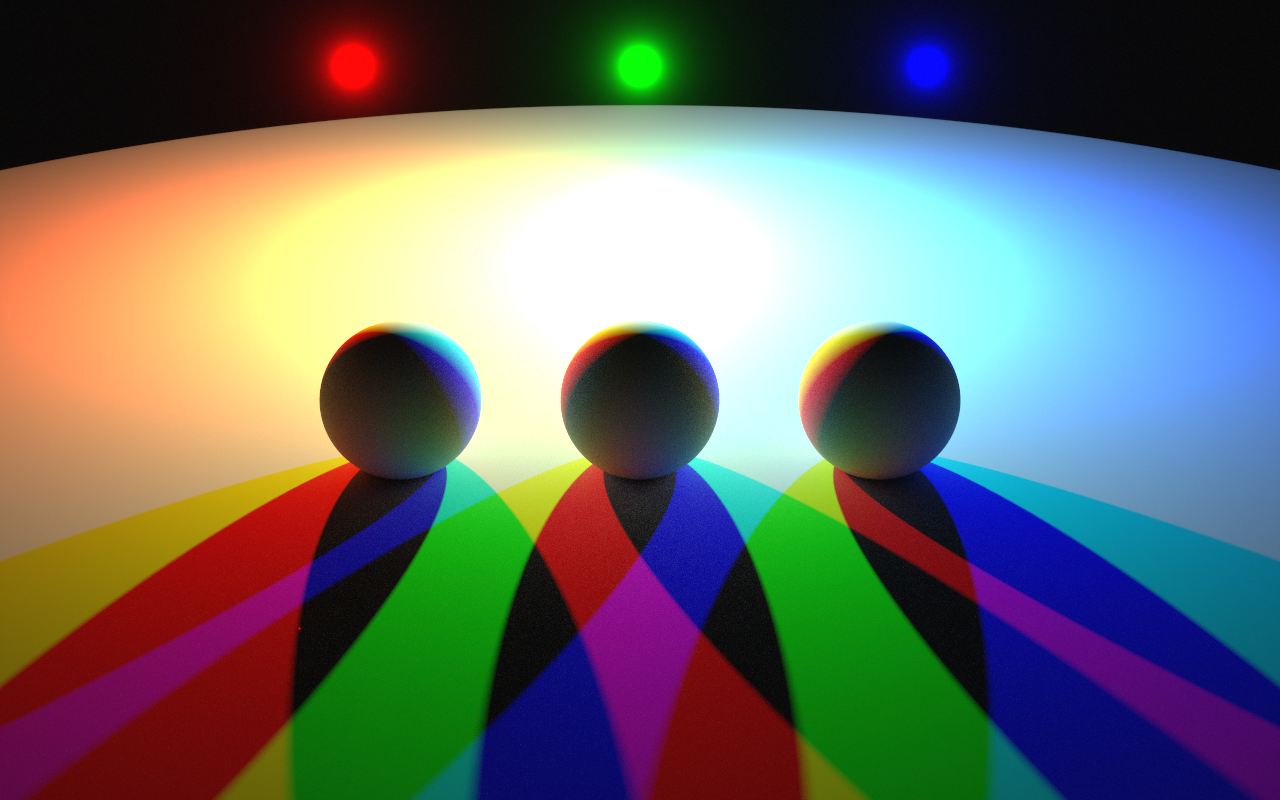
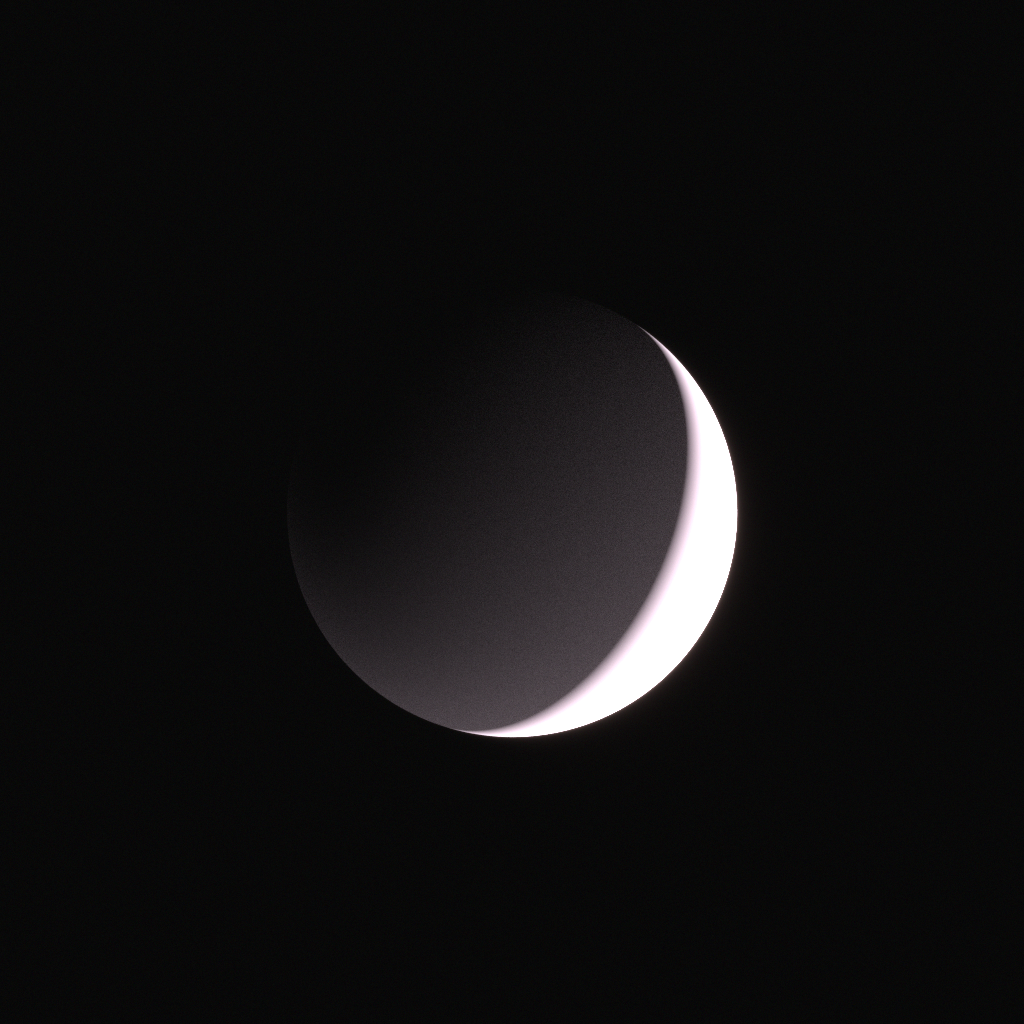
Red, green and blue sphere lights over three spheres, where the colors of the shadows show light adding up, and planetshine: a satellite’s night side, lit by the planet below it as an indirect source.
Colored lights |
Planetshine |
|---|---|
|
|
Data
None: everything in it is built in code.
Run
From this folder, in Python:
python lights.py
or in C++, built as in Running the examples:
../../build/08_lights
Each writes its images to output/, in the folder it runs from.
Source
The complete example, in both languages. View this example on GitHub.
"""
08 - Lights

Demonstrates:
    - Sphere lights, given by their power in each spectral bin (or their total power, in W)
    - Light adds up: three colored lights, and the colors of the shadows where some are blocked
    - Several lights in one scene. Huira samples each light directly at every bounce (next event
      estimation), and weighs that against the BSDF's own samples (multiple importance
      sampling), so several lights converge as quickly as one
    - Indirect sources: marking a sunlit body as a reflector to sample, for planetshine
    - Focusing the camera at a distance (example 10 covers focus)

Builds on: 05 Planetary BRDFs
Data: none

Run:
    python lights.py

Writes:
    output/08_lights.png               three colored lights over three spheres
    output/08_lights_planetshine.png   a satellite's night side, lit by the planet below it
"""

from pathlib import Path

import huira
from huira.rgb import Scene, SceneView, Renderer, SpectralBins, SpectralWatts

from huira.units import Meter as m
from huira.units import Kilometer as km
from huira.units import Millimeter as mm
from huira.units import AstronomicalUnit as au
from huira.units import Millisecond as ms


def render(scene, camera, camera_model, exposure, filename, samples):
    scene_view = SceneView(scene, exposure, camera)
    frame_buffer = camera_model.make_frame_buffer()
    frame_buffer.enable_sensor_response()

    renderer = Renderer()
    renderer.set_samples_per_pixel(samples)
    renderer.set_max_bounces(4)
    camera_model.precompute()
    renderer.render(scene_view, frame_buffer)

    output_dir = Path("output")
    output_dir.mkdir(exist_ok=True)
    huira.write_png(output_dir / filename, huira.linear_to_srgb(frame_buffer.sensor_response))


def colored_lights():
    scene = Scene()
    lambertian = scene.new_bsdf_lambertian()

    # A floor: an ellipsoid flattened into a disk 20 m across and 10 cm thick.
    floor_material = scene.new_material(lambertian)
    floor_material.set_albedo_factor(SpectralBins(0.5))
    floor = scene.add_ellipsoid(m(10), m(10), m(0.05))
    scene.root.new_instance(scene.add_primitive(floor, floor_material))

    # Three white spheres resting on it:
    ball_material = scene.new_material(lambertian)
    ball_material.set_albedo_factor(SpectralBins(0.6))
    ball = scene.add_primitive(scene.add_ellipsoid(m(0.5), m(0.5), m(0.5)), ball_material)
    for x in (-1.5, 0.0, 1.5):
        scene.root.new_instance(ball).set_position(m(x), m(0), m(0.5))

    # A sphere light is a glowing sphere: give it a radius and the power it emits. Here the
    # power is given in each spectral bin (red, green, blue), so each light emits in one bin
    # only: one red, one green and one blue light, 300 W each, in a row behind the spheres and
    # above the row of spheres. (A total power, huira.units.Watt(300), is spread evenly over
    # the bins: a white light.) They are small, 5 cm, so their shadows are sharp; a larger light
    # casts softer ones.
    colors = [(-2.5, [300.0, 0.0, 0.0]), (0.0, [0.0, 300.0, 0.0]), (2.5, [0.0, 0.0, 300.0])]
    for x, power in colors:
        light = scene.new_sphere_light(m(0.05), SpectralWatts(SpectralBins(power)))
        scene.root.new_instance(light).set_position(m(x), m(4), m(1.75))

    # Light adds up. Where all three lights reach the floor, it is white. Each sphere casts a
    # shadow from each light, toward the camera, and only the other two lights reach into it:
    # the red light's shadow is cyan (green and blue), the green light's magenta, and the blue
    # light's yellow. Where two shadows overlap, one light is left, and where all three overlap,
    # none: black.

    camera_model = scene.new_camera_model()
    camera_model.use_blender_convention()
    camera_model.set_focal_length(mm(35))
    camera_model.configure_sensor_from_size((1280, 800), mm(36))
    camera_model.set_fstop(4)

    # At f/4 the depth of field is shallow, and the camera focuses at infinity by default:
    # focus on the spheres instead.
    camera_model.set_focus_distance(m(8))

    camera = scene.root.new_instance(camera_model)
    camera.set_position(m(0), m(-7), m(4))
    camera.look_at(huira.Vec3(0, 0, 0.5), huira.Vec3(0, 0, 1))

    time = huira.Time("2026-01-01T00:00:00")
    render(scene, camera, camera_model, huira.Interval.from_start(time, ms(5)),
           "08_lights.png", samples=256)


def planetshine():
    scene = Scene()
    lambertian = scene.new_bsdf_lambertian()

    # A planet 6000 km in radius, and a satellite 1 m in radius, 500 km above its north pole:
    planet_material = scene.new_material(lambertian)
    planet_material.set_albedo_factor(SpectralBins(0.3))
    planet_shape = scene.add_ellipsoid(km(6000), km(6000), km(6000))
    planet = scene.root.new_instance(scene.add_primitive(planet_shape, planet_material))

    satellite_material = scene.new_material(lambertian)
    satellite_material.set_albedo_factor(SpectralBins(0.8))
    satellite_shape = scene.add_ellipsoid(m(1), m(1), m(1))
    satellite = scene.root.new_instance(scene.add_primitive(satellite_shape, satellite_material))
    satellite.set_position(m(0), m(0), km(6500))

    # The Sun lights the planet's +x half, and the satellite's +x side.
    sun = scene.root.new_instance(scene.new_sun_light())
    sun.set_position(au(1), m(0), m(0))

    # The satellite's other side is lit only by sunlight reflected off the planet. Marking the
    # planet as an indirect source makes the renderer sample it like a light (it emits nothing
    # itself), as it does the Sun. That matters most when the reflector is small in the sky,
    # such as the Moon seen from the Earth, where paths would rarely find it by chance.
    planet.set_indirect_source(True)

    # The camera looks up at the satellite from below its night side:
    camera_model = scene.new_camera_model()
    camera_model.use_blender_convention()
    camera_model.set_focal_length(mm(50))
    camera_model.configure_sensor_from_size((1024, 1024), mm(36))
    camera_model.set_fstop(16)

    camera = scene.root.new_instance(camera_model)
    camera.set_position(m(-4), m(-4), m(6500e3 - 3))
    camera.look_at(satellite, huira.Vec3(0, 0, 1))

    time = huira.Time("2026-01-01T00:00:00")
    render(scene, camera, camera_model, huira.Interval.from_start(time, ms(1)),
           "08_lights_planetshine.png", samples=256)


def main():
    colored_lights()
    planetshine()


if __name__ == "__main__":
    main()
// 08 - Lights
//
// Demonstrates:
//   - Sphere lights, given by their power in each spectral bin (or their total power, in W)
//   - Light adds up: three colored lights, and the colors of the shadows where some are blocked
//   - Several lights in one scene. Huira samples each light directly at every bounce (next event
//     estimation), and weighs that against the BSDF's own samples (multiple importance
//     sampling), so several lights converge as quickly as one
//   - Indirect sources: marking a sunlit body as a reflector to sample, for planetshine
//   - Focusing the camera at a distance (example 10 covers focus)
//
// Builds on: 05 Planetary BRDFs
// Data: none
//
// Run:
//   ./08_lights
//
// Writes:
//   output/08_lights.png               three colored lights over three spheres
//   output/08_lights_planetshine.png   a satellite's night side, lit by the planet below it

#include <filesystem>
#include <string>
#include <utility>

#include "huira/huira.hpp"

namespace fs = std::filesystem;

using namespace huira::units::literals;

using TSpectral = huira::RGB;

static void render(huira::Scene<TSpectral>& scene,
                   const huira::InstanceHandle<TSpectral>& camera,
                   const huira::CameraModelHandle<TSpectral>& camera_model,
                   const huira::Interval& exposure,
                   const std::string& filename,
                   int samples)
{
    huira::SceneView<TSpectral> scene_view(scene, exposure, camera);
    auto frame_buffer = camera_model.make_frame_buffer();
    frame_buffer.enable_sensor_response();

    huira::Renderer<TSpectral> renderer;
    renderer.set_samples_per_pixel(samples);
    renderer.set_max_bounces(4);
    camera_model.precompute();
    renderer.render(scene_view, frame_buffer);

    fs::create_directories("output");
    huira::write_image_png(fs::path("output") / filename,
                           huira::linear_to_srgb(frame_buffer.sensor_response()));
}

static void colored_lights()
{
    huira::Scene<TSpectral> scene;
    auto lambertian = scene.new_bsdf_lambertian();

    // A floor: an ellipsoid flattened into a disk 20 m across and 10 cm thick.
    auto floor_material = scene.new_material(lambertian);
    floor_material.set_albedo_factor(TSpectral{0.5f});
    auto floor_shape = scene.add_ellipsoid(10_m, 10_m, 0.05_m);
    scene.root.new_instance(scene.add_primitive(floor_shape, floor_material));

    // Three white spheres resting on it:
    auto ball_material = scene.new_material(lambertian);
    ball_material.set_albedo_factor(TSpectral{0.6f});
    auto ball = scene.add_primitive(scene.add_ellipsoid(0.5_m, 0.5_m, 0.5_m), ball_material);
    for (double x : {-1.5, 0.0, 1.5}) {
        scene.root.new_instance(ball).set_position(huira::units::Meter(x), 0_m, 0.5_m);
    }

    // A sphere light is a glowing sphere: give it a radius and the power it emits. Here the
    // power is given in each spectral bin (red, green, blue), so each light emits in one bin
    // only: one red, one green and one blue light, 300 W each, in a row behind the spheres and
    // above the row of spheres. (A total power, 300_W, is spread evenly over the bins: a
    // white light.) They are small, 5 cm, so their shadows are sharp; a larger light casts
    // softer ones.
    const std::pair<double, TSpectral> colors[] = {
        {-2.5, TSpectral{300.f, 0.f, 0.f}},
        {0.0, TSpectral{0.f, 300.f, 0.f}},
        {2.5, TSpectral{0.f, 0.f, 300.f}},
    };
    for (const auto& [x, power] : colors) {
        auto light = scene.new_sphere_light(0.05_m, huira::units::SpectralWatts<TSpectral>(power));
        scene.root.new_instance(light).set_position(huira::units::Meter(x), 4_m, 1.75_m);
    }

    // Light adds up. Where all three lights reach the floor, it is white. Each sphere casts a
    // shadow from each light, toward the camera, and only the other two lights reach into it:
    // the red light's shadow is cyan (green and blue), the green light's magenta, and the blue
    // light's yellow. Where two shadows overlap, one light is left, and where all three overlap,
    // none: black.

    auto camera_model = scene.new_camera_model();
    camera_model.use_blender_convention();
    camera_model.set_focal_length(35_mm);
    camera_model.configure_sensor_from_size({1280, 800}, 36_mm);
    camera_model.set_fstop(4);

    // At f/4 the depth of field is shallow, and the camera focuses at infinity by default:
    // focus on the spheres instead.
    camera_model.set_focus_distance(8_m);

    auto camera = scene.root.new_instance(camera_model);
    camera.set_position(0_m, -7_m, 4_m);
    camera.look_at(huira::Vec3<double>{0.0, 0.0, 0.5}, huira::Vec3<double>{0.0, 0.0, 1.0});

    const huira::Time time("2026-01-01T00:00:00");
    render(
        scene, camera, camera_model, huira::Interval::from_start(time, 5_ms), "08_lights.png", 256);
}

static void planetshine()
{
    huira::Scene<TSpectral> scene;
    auto lambertian = scene.new_bsdf_lambertian();

    // A planet 6000 km in radius, and a satellite 1 m in radius, 500 km above its north pole:
    auto planet_material = scene.new_material(lambertian);
    planet_material.set_albedo_factor(TSpectral{0.3f});
    auto planet_shape = scene.add_ellipsoid(6000_Km, 6000_Km, 6000_Km);
    auto planet = scene.root.new_instance(scene.add_primitive(planet_shape, planet_material));

    auto satellite_material = scene.new_material(lambertian);
    satellite_material.set_albedo_factor(TSpectral{0.8f});
    auto satellite_shape = scene.add_ellipsoid(1_m, 1_m, 1_m);
    auto satellite =
        scene.root.new_instance(scene.add_primitive(satellite_shape, satellite_material));
    satellite.set_position(0_m, 0_m, 6500_Km);

    // The Sun lights the planet's +x half, and the satellite's +x side.
    auto sun = scene.root.new_instance(scene.new_sun_light());
    sun.set_position(1_au, 0_m, 0_m);

    // The satellite's other side is lit only by sunlight reflected off the planet. Marking the
    // planet as an indirect source makes the renderer sample it like a light (it emits nothing
    // itself), as it does the Sun. That matters most when the reflector is small in the sky,
    // such as the Moon seen from the Earth, where paths would rarely find it by chance.
    planet.set_indirect_source(true);

    // The camera looks up at the satellite from below its night side:
    auto camera_model = scene.new_camera_model();
    camera_model.use_blender_convention();
    camera_model.set_focal_length(50_mm);
    camera_model.configure_sensor_from_size({1024, 1024}, 36_mm);
    camera_model.set_fstop(16);

    auto camera = scene.root.new_instance(camera_model);
    camera.set_position(-4_m, -4_m, huira::units::Meter(6500e3 - 3.0));
    camera.look_at(satellite, huira::Vec3<double>{0.0, 0.0, 1.0});

    const huira::Time time("2026-01-01T00:00:00");
    render(scene,
           camera,
           camera_model,
           huira::Interval::from_start(time, 1_ms),
           "08_lights_planetshine.png",
           256);
}

int main()
{
    colored_lights();
    planetshine();
}