04 - Truth data
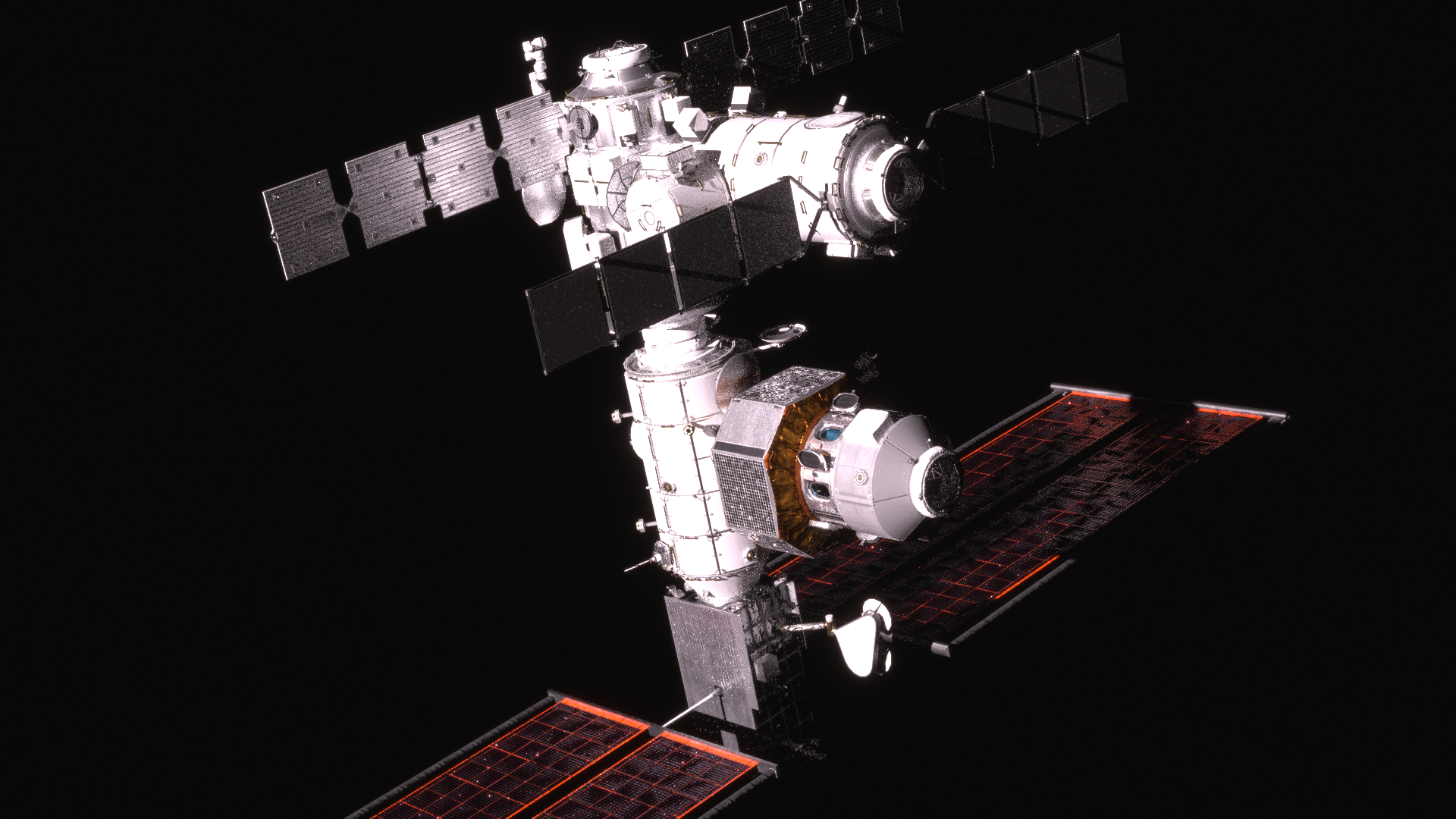
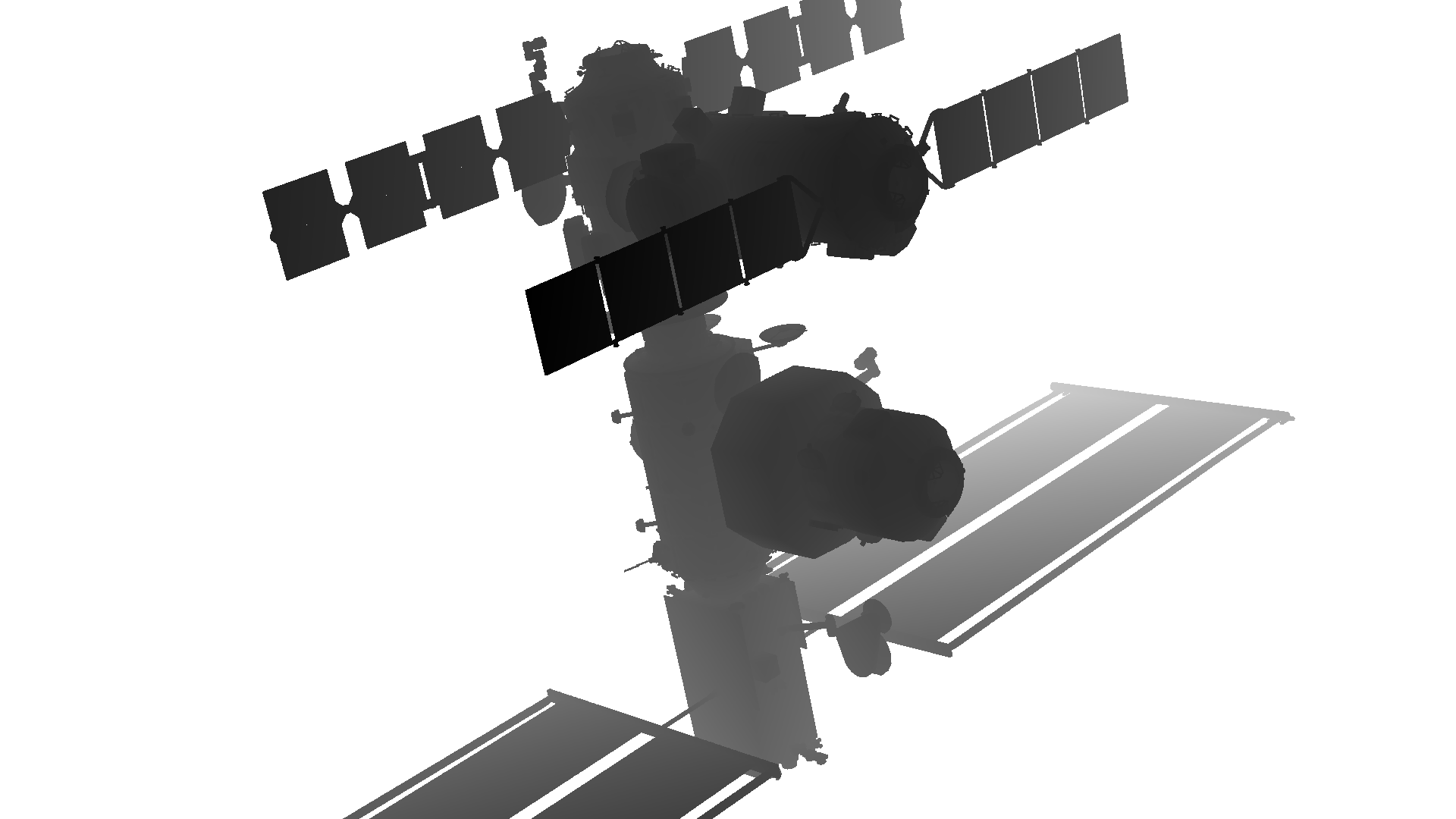
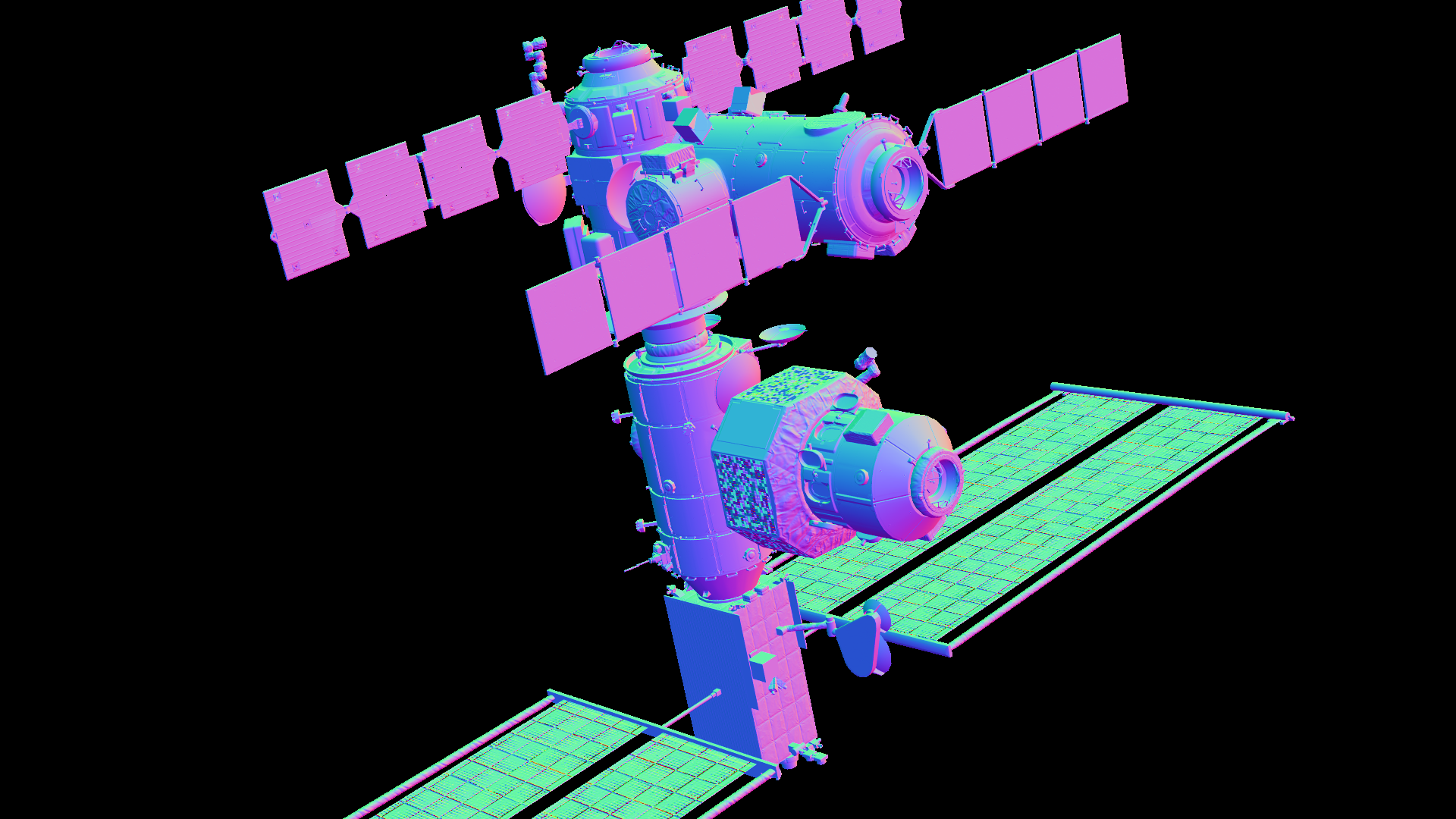
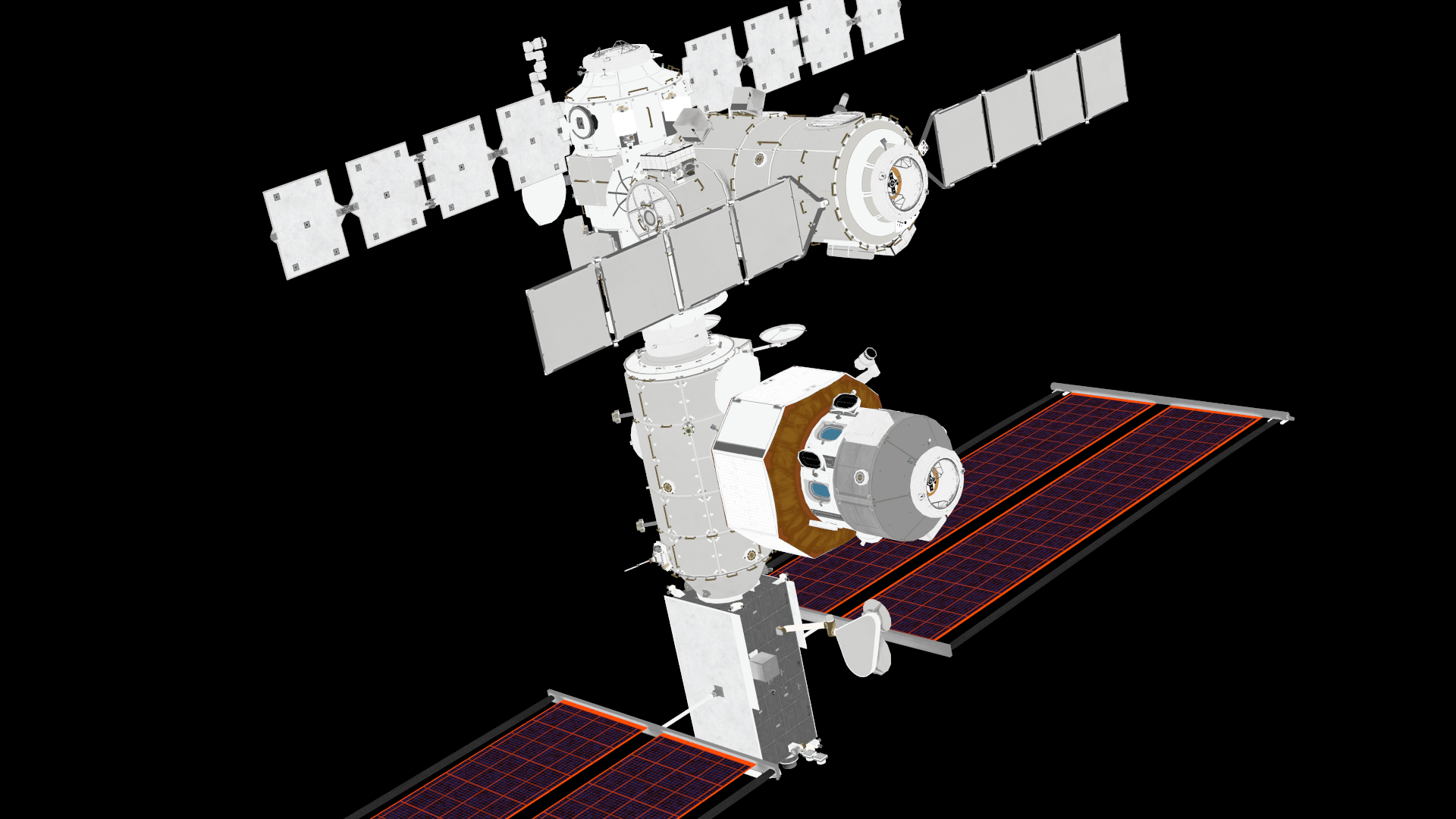
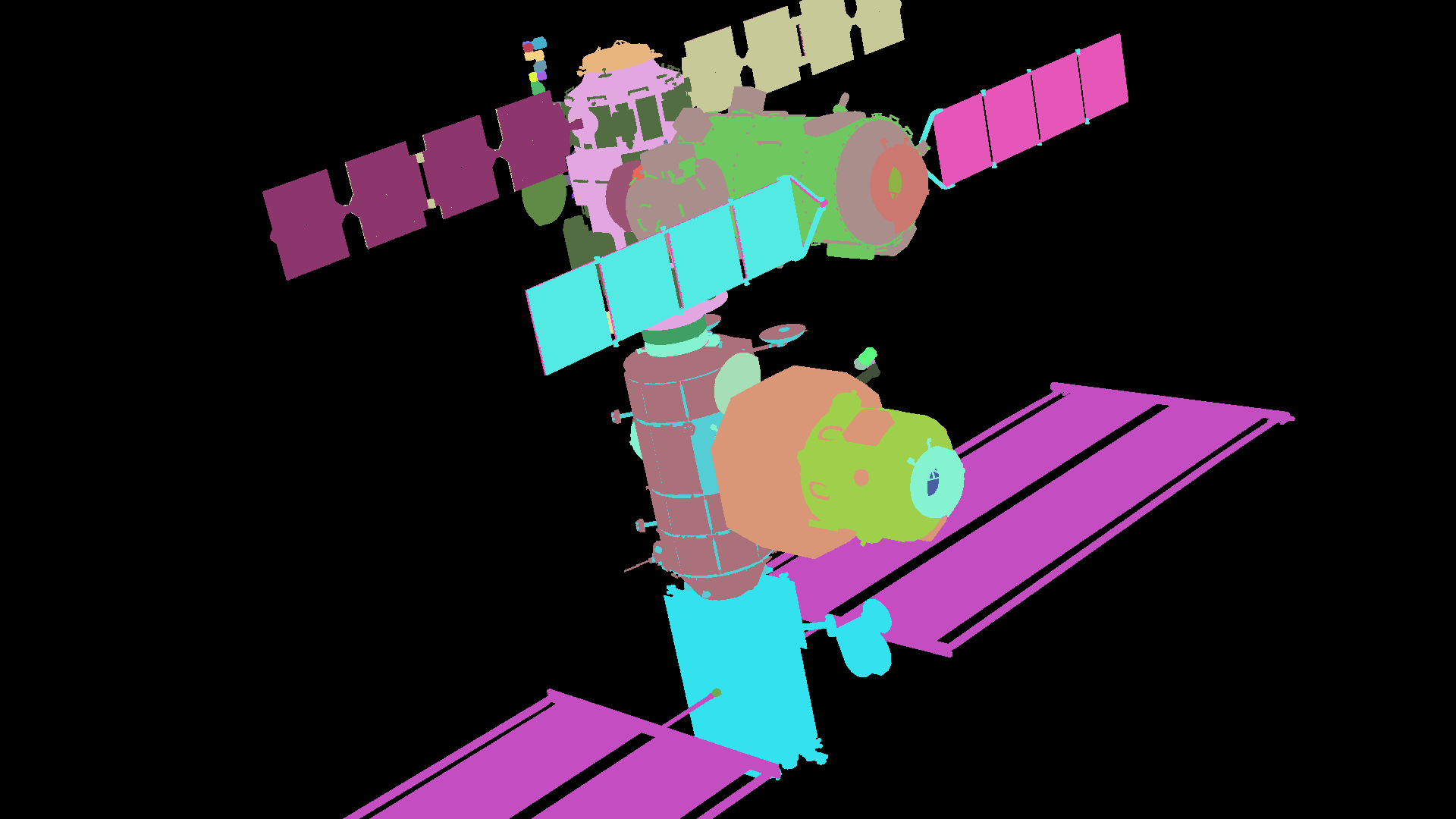
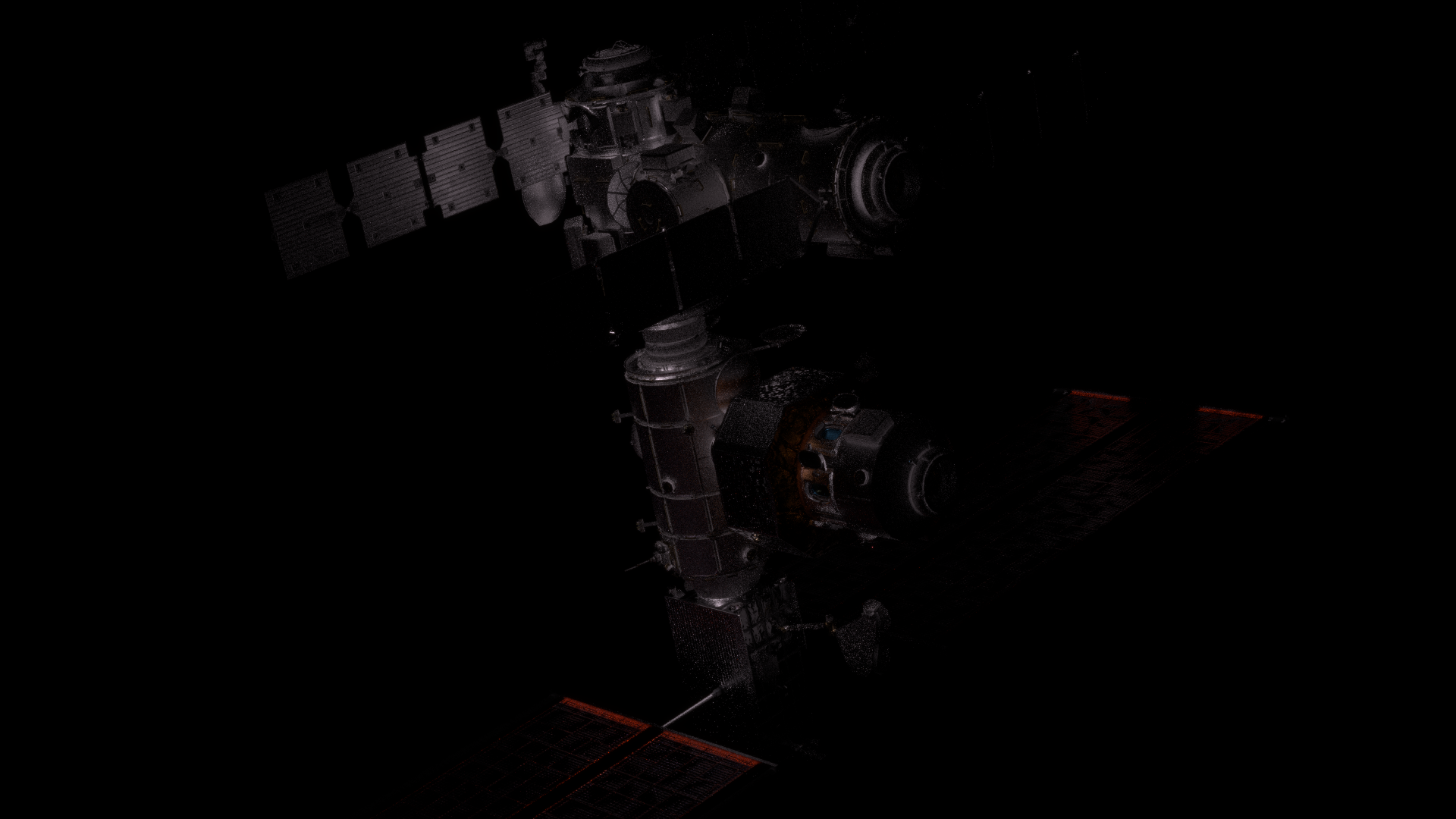
The images a render can make besides the picture: depth, normals, albedo, geometry IDs and received power. And ray queries, which ask the scene what lies along a ray.
Rendered image |
Depth |
Normals |
|---|---|---|
|
|
|
Albedo |
Geometry IDs |
Indirect light |
|
|
|
Data
File |
What it is |
From |
|---|---|---|
|
NASA’s model of the Gateway |
Download it into this folder:
curl -fLO https://media.huira.space/data/models/nasa/gateway.glb
Licenses, and how to credit the data: Gateway model.
Run
From this folder, in Python:
python truth_data.py gateway.glb
or in C++, built as in Running the examples:
../../build/04_truth_data gateway.glb
Each writes its images to output/, in the folder it runs from.
Source
The complete example, in both languages. View this example on GitHub.
"""
04 - Truth data

Demonstrates:
    - The frame buffer's other images: depth, camera and world normals, albedo, geometry IDs,
      and the power each pixel receives (in total, and directly and indirectly)
    - Viewing them: depth_map and normal_map, and normalizing with numpy
    - Saving float data losslessly as FITS
    - Ray queries: casting a camera ray through a pixel, intersecting it with the scene, and
      resolving the hit into the surface's position and normal
    - Projecting a point onto the image, and pixel coordinate conventions (OpenCV and FITS)

Builds on: 03 Load a model
Data: gateway.glb, NASA's model of the Gateway (see README.md)

Run:
    python truth_data.py gateway.glb

Writes:
    output/04_truth_data.png             the rendered image
    output/04_truth_data_depth.png       the distance to each pixel's surface, as a picture...
    output/04_truth_data_depth.fits      ...and in meters
    output/04_truth_data_normals.png     the surface normals, in the camera's frame
    output/04_truth_data_albedo.png      the surface albedo
    output/04_truth_data_ids.png         which geometry each pixel sees, one color each
    output/04_truth_data_indirect.png    the light each pixel receives after bouncing
"""

import sys
from pathlib import Path

import numpy as np

import huira
from huira.rgb import Scene, SceneView, Renderer, Image

from huira.units import Meter as m
from huira.units import Millimeter as mm
from huira.units import Degree as deg
from huira.units import AstronomicalUnit as au
from huira.units import Millisecond as ms


def normalized(image):
    """An image scaled so its brightest value is 1, as numpy can do with any buffer."""
    array = image.to_numpy()
    peak = np.nanmax(array)
    return Image((array / peak if peak > 0 else array).astype(np.float32))


def id_colors(geometry_ids):
    """A color for each geometry ID, and black where a pixel saw nothing."""
    ids = geometry_ids.to_numpy()
    missed = ids == np.iinfo(np.uint64).max
    rng = np.random.default_rng(0)
    palette = rng.uniform(0.2, 1.0, size=(256, 3)).astype(np.float32)
    colors = palette[(ids % 256).astype(np.int64)]
    colors[missed] = 0.0
    return Image(colors)


def main():
    if len(sys.argv) != 2:
        sys.exit("Usage: python truth_data.py <gateway.glb>\nREADME.md says where to get it.")
    model_path = Path(sys.argv[1])

    # The scene of example 03:
    scene = Scene()
    gateway_model = scene.load_model(model_path)
    gateway = scene.root.new_instance(gateway_model)

    sun = scene.root.new_instance(scene.new_sun_light())
    sun.set_position(m(0), au(-1), m(0))

    camera_model = scene.new_camera_model()
    camera_model.use_blender_convention()
    camera_model.set_focal_length(mm(50))
    camera_model.configure_sensor_from_size((1920, 1080), mm(36))
    camera_model.set_fstop(16)

    camera = scene.root.new_instance(camera_model)
    camera.set_position(m(40), m(-40), m(0))
    camera.set_euler_angles(deg(95), deg(0), deg(45))

    time = huira.Time("2026-01-01T00:00:00")
    exposure = huira.Interval.from_start(time, ms(1))
    scene_view = SceneView(scene, exposure, camera)

    # Besides the sensor response, a frame buffer can hold images of what each pixel sees. Each
    # is filled only if enabled, since each costs memory and time:
    #   - depth: the distance along the ray to the nearest surface, in meters
    #   - camera_normals / world_normals: the surface normal, in the camera's or world's frame
    #   - albedo: the surface albedo
    #   - geometry_ids: which geometry the pixel sees
    #   - received_power: the power the pixel collects (W, in each spectral bin), split into
    #     received_direct_power (straight from the lights) and received_indirect_power (after
    #     bouncing off other surfaces)
    frame_buffer = camera_model.make_frame_buffer()
    frame_buffer.enable_sensor_response()
    frame_buffer.enable_depth()
    frame_buffer.enable_camera_normals()
    frame_buffer.enable_world_normals()
    frame_buffer.enable_albedo()
    frame_buffer.enable_geometry_ids()
    frame_buffer.enable_received_direct_power()
    frame_buffer.enable_received_indirect_power()

    renderer = Renderer()
    renderer.set_samples_per_pixel(64)
    renderer.set_max_bounces(3)
    renderer.render(scene_view, frame_buffer)

    output_dir = Path("output")
    output_dir.mkdir(exist_ok=True)
    huira.write_png(
        output_dir / "04_truth_data.png", huira.linear_to_srgb(frame_buffer.sensor_response)
    )

    # depth_map and normal_map turn depth and normals into pictures. FITS keeps the depth itself,
    # as 32-bit floats:
    huira.write_png(output_dir / "04_truth_data_depth.png", huira.depth_map(frame_buffer.depth))
    huira.write_fits(output_dir / "04_truth_data_depth.fits", frame_buffer.depth)
    huira.write_png(
        output_dir / "04_truth_data_normals.png", huira.normal_map(frame_buffer.camera_normals)
    )

    # The other images are arrays like any other (to_numpy()), to scale or color as needed:
    huira.write_png(
        output_dir / "04_truth_data_albedo.png", huira.linear_to_srgb(frame_buffer.albedo)
    )
    huira.write_png(output_dir / "04_truth_data_ids.png", id_colors(frame_buffer.geometry_ids))
    huira.write_png(
        output_dir / "04_truth_data_indirect.png",
        huira.linear_to_srgb(normalized(frame_buffer.received_indirect_power)),
    )

    # Ray queries ask the scene what is along a ray, without rendering. Take the pixel nearest the
    # image's center that sees something (its depth is finite; where a pixel sees nothing, the
    # depth is infinite):
    depth = frame_buffer.depth.to_numpy()
    rows, cols = np.nonzero(np.isfinite(depth))
    if rows.size == 0:
        print("The camera sees nothing")
        return
    height, width = depth.shape
    nearest = np.argmin((cols - width / 2) ** 2 + (rows - height / 2) ** 2)
    x, y = int(cols[nearest]), int(rows[nearest])

    # cast_ray gives the ray through the pixel's center; SceneView.intersect traces it. Both work
    # in the camera's frame, so the hit point is relative to the camera.
    ray = camera_model.cast_ray(x, y)
    hit = scene_view.intersect(ray)
    if not hit.hit():
        print(f"The ray through the center of pixel ({x}, {y}) misses")
        return

    point = ray.at(hit.t)
    print(f"Pixel ({x}, {y}) sees geometry {hit.geom_id} at {hit.t:.3f} m")
    print(f"  The depth image has {depth[y, x]:.3f} m there (its nearest hit over the pixel)")

    # resolve_hit fills in the surface at the hit: its position, normals and texture coordinates.
    surface = scene_view.resolve_hit(ray, hit)
    print(f"  Surface normal: {surface.normal_s}")

    # project_point goes the other way, from a point in the camera's frame to the image. Pixel
    # coordinates follow the camera's pixel convention: OpenCV's by default (the first pixel's
    # center at (0, 0), y down), or others such as FITS's (the first pixel's center at (1, 1),
    # y up):
    print(f"  It projects to {camera_model.project_point(point)} (OpenCV convention)")
    camera_model.set_pixel_convention(huira.PixelConvention.fits())
    print(f"  It projects to {camera_model.project_point(point)} (FITS convention)")
    camera_model.set_pixel_convention(huira.PixelConvention.opencv())


if __name__ == "__main__":
    main()
// 04 - Truth data
//
// Demonstrates:
//   - The frame buffer's other images: depth, camera and world normals, albedo, geometry IDs,
//     and the power each pixel receives (in total, and directly and indirectly)
//   - Viewing them: depth_map and normal_map, and normalizing an image
//   - Saving float data losslessly as FITS
//   - Ray queries: casting a camera ray through a pixel, intersecting it with the scene, and
//     resolving the hit into the surface's position and normal
//   - Projecting a point onto the image, and pixel coordinate conventions (OpenCV and FITS)
//
// Builds on: 03 Load a model
// Data: gateway.glb, NASA's model of the Gateway (see README.md)
//
// Run:
//   ./04_truth_data gateway.glb
//
// Writes:
//   output/04_truth_data.png             the rendered image
//   output/04_truth_data_depth.png       the distance to each pixel's surface, as a picture...
//   output/04_truth_data_depth.fits      ...and in meters
//   output/04_truth_data_normals.png     the surface normals, in the camera's frame
//   output/04_truth_data_albedo.png      the surface albedo
//   output/04_truth_data_ids.png         which geometry each pixel sees, one color each
//   output/04_truth_data_indirect.png    the light each pixel receives after bouncing

#include <algorithm>
#include <cmath>
#include <cstdint>
#include <filesystem>
#include <iostream>
#include <limits>

#include "huira/huira.hpp"

namespace fs = std::filesystem;

using namespace huira::units::literals;

using TSpectral = huira::RGB;

// An image scaled so its brightest value is 1.
static huira::Image<huira::RGB> normalized(const huira::Image<huira::RGB>& image)
{
    float peak = 0.f;
    for (int y = 0; y < image.height(); ++y) {
        for (int x = 0; x < image.width(); ++x) {
            peak = std::max(peak, image(x, y).max());
        }
    }
    const float scale = peak > 0.f ? 1.f / peak : 1.f;

    huira::Image<huira::RGB> output(image.width(), image.height());
    for (int y = 0; y < image.height(); ++y) {
        for (int x = 0; x < image.width(); ++x) {
            huira::RGB value = image(x, y);
            value *= scale;
            output(x, y) = value;
        }
    }
    return output;
}

// A color for each geometry ID, and black where a pixel saw nothing.
static huira::Image<huira::RGB> id_colors(const huira::Image<std::uint64_t>& ids)
{
    huira::Image<huira::RGB> output(ids.width(), ids.height());
    for (int y = 0; y < ids.height(); ++y) {
        for (int x = 0; x < ids.width(); ++x) {
            const std::uint64_t id = ids(x, y);
            if (id == std::numeric_limits<std::uint64_t>::max()) {
                output(x, y) = huira::RGB{0.f};
                continue;
            }
            // A repeatable pseudo-random color for each ID:
            const std::uint64_t h = (id + 1) * 0x9E3779B97F4A7C15ull;
            auto channel = [h](int shift) {
                return 0.2f + 0.8f * static_cast<float>((h >> shift) & 0xFF) / 255.f;
            };
            output(x, y) = huira::RGB{channel(16), channel(32), channel(48)};
        }
    }
    return output;
}

int main(int argc, char** argv)
{
    if (argc != 2) {
        std::cerr << "Usage: 04_truth_data <gateway.glb>\nREADME.md says where to get it.\n";
        return 1;
    }
    const fs::path model_path = argv[1];

    // The scene of example 03:
    huira::Scene<TSpectral> scene;
    auto gateway_model = scene.load_model(model_path);
    auto gateway = scene.root.new_instance(gateway_model);

    auto sun = scene.root.new_instance(scene.new_sun_light());
    sun.set_position(0_m, -1_au, 0_m);

    auto camera_model = scene.new_camera_model();
    camera_model.use_blender_convention();
    camera_model.set_focal_length(50_mm);
    camera_model.configure_sensor_from_size({1920, 1080}, 36_mm);
    camera_model.set_fstop(16);

    auto camera = scene.root.new_instance(camera_model);
    camera.set_position(40_m, -40_m, 0_m);
    camera.set_euler_angles(95_deg, 0_deg, 45_deg);

    huira::Time time("2026-01-01T00:00:00");
    huira::Interval exposure = huira::Interval::from_start(time, 1_ms);
    huira::SceneView<TSpectral> scene_view(scene, exposure, camera);

    // Besides the sensor response, a frame buffer can hold images of what each pixel sees. Each
    // is filled only if enabled, since each costs memory and time:
    //   - depth: the distance along the ray to the nearest surface, in meters
    //   - camera_normals / world_normals: the surface normal, in the camera's or world's frame
    //   - albedo: the surface albedo
    //   - geometry_ids: which geometry the pixel sees
    //   - received_power: the power the pixel collects (W, in each spectral bin), split into
    //     received_direct_power (straight from the lights) and received_indirect_power (after
    //     bouncing off other surfaces)
    auto frame_buffer = camera_model.make_frame_buffer();
    frame_buffer.enable_sensor_response();
    frame_buffer.enable_depth();
    frame_buffer.enable_camera_normals();
    frame_buffer.enable_world_normals();
    frame_buffer.enable_albedo();
    frame_buffer.enable_geometry_ids();
    frame_buffer.enable_received_direct_power();
    frame_buffer.enable_received_indirect_power();

    huira::Renderer<TSpectral> renderer;
    renderer.set_samples_per_pixel(64);
    renderer.set_max_bounces(3);
    renderer.render(scene_view, frame_buffer);

    fs::create_directories("output");
    huira::write_image_png("output/04_truth_data.png",
                           huira::linear_to_srgb(frame_buffer.sensor_response()));

    // depth_map and normal_map turn depth and normals into pictures. FITS keeps the depth itself,
    // as 32-bit floats:
    huira::write_image_png("output/04_truth_data_depth.png",
                           huira::depth_map(frame_buffer.depth()));
    huira::write_image_fits("output/04_truth_data_depth.fits", frame_buffer.depth());
    huira::write_image_png("output/04_truth_data_normals.png",
                           huira::normal_map(frame_buffer.camera_normals()));

    // The other images are images like any other, to scale or color as needed:
    huira::write_image_png("output/04_truth_data_albedo.png",
                           huira::linear_to_srgb(frame_buffer.albedo()));
    huira::write_image_png("output/04_truth_data_ids.png", id_colors(frame_buffer.geometry_ids()));
    huira::write_image_png(
        "output/04_truth_data_indirect.png",
        huira::linear_to_srgb(normalized(frame_buffer.received_indirect_power())));

    // Ray queries ask the scene what is along a ray, without rendering. Take the pixel nearest the
    // image's center that sees something (its depth is finite; where a pixel sees nothing, the
    // depth is infinite):
    const huira::Image<float>& depth = frame_buffer.depth();
    int x = -1;
    int y = -1;
    double nearest = std::numeric_limits<double>::infinity();
    for (int row = 0; row < depth.height(); ++row) {
        for (int col = 0; col < depth.width(); ++col) {
            if (std::isfinite(depth(col, row))) {
                const double dx = col - depth.width() / 2.0;
                const double dy = row - depth.height() / 2.0;
                if (dx * dx + dy * dy < nearest) {
                    nearest = dx * dx + dy * dy;
                    x = col;
                    y = row;
                }
            }
        }
    }
    if (x < 0) {
        std::cout << "The camera sees nothing\n";
        return 0;
    }

    // cast_ray gives the ray through the pixel's center; SceneView::intersect traces it. Both work
    // in the camera's frame, so the hit point is relative to the camera.
    huira::Ray<TSpectral> ray = camera_model.cast_ray(x, y);
    huira::HitRecord hit = scene_view.intersect(ray);
    if (!hit.hit()) {
        std::cout << "The ray through the center of pixel (" << x << ", " << y << ") misses\n";
        return 0;
    }

    const huira::Vec3<float> point = ray.at(hit.t);
    std::cout << "Pixel (" << x << ", " << y << ") sees geometry " << hit.geom_id << " at " << hit.t
              << " m\n";
    std::cout << "  The depth image has " << depth(x, y)
              << " m there (its nearest hit over the pixel)\n";

    // resolve_hit fills in the surface at the hit: its position, normals and texture coordinates.
    const huira::Interaction<TSpectral> surface = scene_view.resolve_hit(ray, hit);
    std::cout << "  Surface normal: (" << surface.normal_s.x << ", " << surface.normal_s.y << ", "
              << surface.normal_s.z << ")\n";

    // project_point goes the other way, from a point in the camera's frame to the image. Pixel
    // coordinates follow the camera's pixel convention: OpenCV's by default (the first pixel's
    // center at (0, 0), y down), or others such as FITS's (the first pixel's center at (1, 1),
    // y up):
    huira::Pixel opencv_pixel = camera_model.project_point(point);
    camera_model.set_pixel_convention(huira::PixelConvention::fits());
    huira::Pixel fits_pixel = camera_model.project_point(point);
    camera_model.set_pixel_convention(huira::PixelConvention::opencv());

    std::cout << "  It projects to (" << opencv_pixel.x << ", " << opencv_pixel.y
              << ") (OpenCV convention)\n";
    std::cout << "  It projects to (" << fits_pixel.x << ", " << fits_pixel.y
              << ") (FITS convention)\n";
}