11 - Sensor
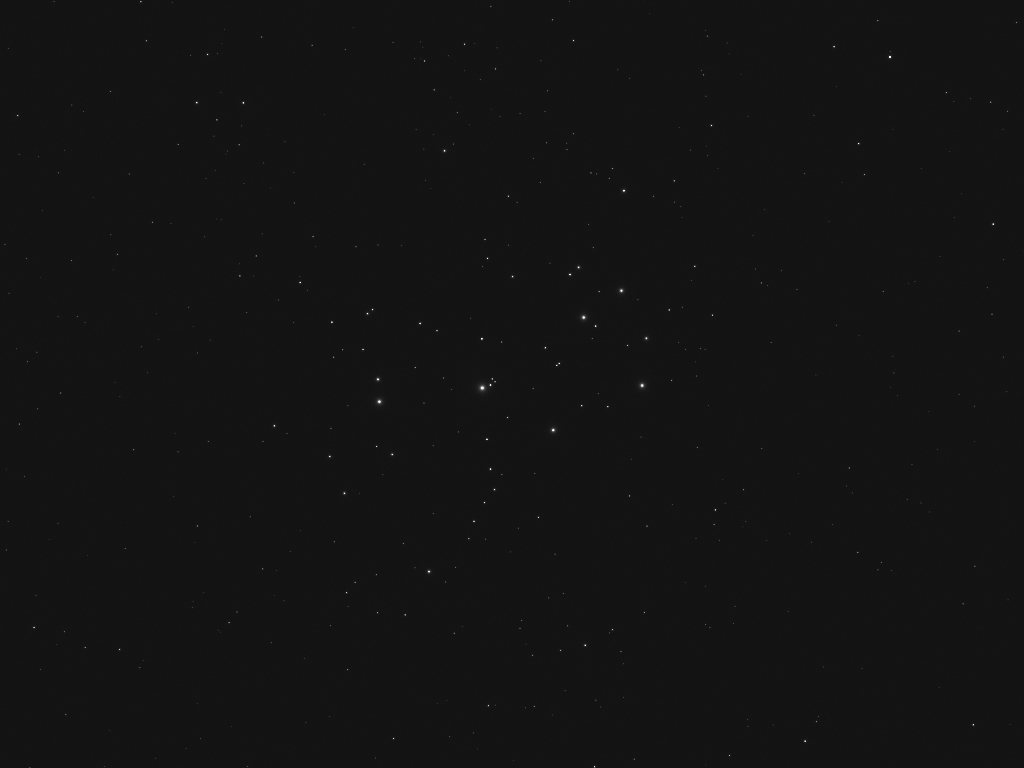
The sensor that turns light into digital numbers: quantum efficiency, gain, bit depth and noise, with the result saved as FITS and TIFF.
Data
File |
What it is |
From |
|---|---|---|
|
The Tycho-2 star catalog, in Huira’s format |
You will need this catalog whenever you render stars with Huira: in the later examples, and in your own scenes, which for a space scene is almost always. It is about 120 MB, so keep one copy somewhere central on your machine rather than in this folder, and pass its path wherever you load stars. From the folder you choose, download it with:
curl -fLO https://media.huira.space/data/stars/tycho2/tycho2.hrsc
The Tycho-2 catalog is licensed for non-commercial use only.
Licenses, and how to credit the data: Tycho-2 star catalog.
Run
From this folder, in Python:
python sensor.py /path/to/tycho2.hrsc
or in C++, built as in Running the examples:
../../build/11_sensor /path/to/tycho2.hrsc
Each writes its images to output/, in the folder it runs from.
Source
The complete example, in both languages. View this example on GitHub.
"""
11 - Sensor

Demonstrates:
    - The sensor's geometry: resolution, pixel pitch and principal point
    - Turning photons into digital numbers (DN): quantum efficiency, full well capacity,
      conversion gain (or gain in dB), bias level and bit depth
    - Noise: shot noise and read noise (on by default), dark current, and the noise seed
    - The physical signal chain (huira.visible8): each pixel collects one value from every
      spectral bin, as a real photosite does, where huira.rgb fills three color channels
    - Saving the raw DN: 16-bit FITS with header metadata and a world coordinate system (WCS),
      and 16-bit TIFF; reading the FITS back
    - The same frame without noise, for comparison

Builds on: 10 Optics
Data: tycho2.hrsc, the Tycho-2 star catalog (see README.md)

Run:
    python sensor.py tycho2.hrsc

Writes:
    output/11_sensor.png             the readout, as a picture
    output/11_sensor.fits            ...as DN, with a header
    output/11_sensor.tif             ...as DN
    output/11_sensor_noiseless.png   the same frame without shot or read noise
"""

import math
import sys
from pathlib import Path

import huira
from huira.visible8 import Scene, SceneView, Renderer

from huira.units import Millimeter as mm
from huira.units import Micrometer as um
from huira.units import Second as sec


def direction(ra_deg, dec_deg):
    """The unit vector toward a right ascension and declination, in the J2000 frame."""
    ra = math.radians(ra_deg)
    dec = math.radians(dec_deg)
    return huira.Vec3(math.cos(dec) * math.cos(ra), math.cos(dec) * math.sin(ra), math.sin(dec))


def main():
    if len(sys.argv) != 2:
        sys.exit("Usage: python sensor.py <tycho2.hrsc>\nREADME.md says where to get it.")
    catalog = Path(sys.argv[1])
    output_dir = Path("output")
    output_dir.mkdir(exist_ok=True)

    # This example renders with huira.visible8 rather than huira.rgb. huira.rgb is a special case
    # for making pictures: it fills the sensor response's red, green and blue channels
    # separately, as renderers usually do, though no real photosite works that way. The other
    # spectral types (huira.visible8, huira.swir8) run the real signal chain: each pixel collects
    # one pile of electrons, from every spectral bin, weighted by the quantum efficiency, so the
    # sensor response is one value per pixel, as from a monochrome sensor. Their eight bins are
    # the spectral sampling, not color channels; color from them takes filters, with an
    # exposure through each, as on a real instrument.
    scene = Scene()
    time = huira.Time("2026-01-01T00:00:00")
    scene.load_stars(catalog, time, 12.0)

    camera_model = scene.new_camera_model()
    camera_model.set_focal_length(mm(100))
    camera_model.set_fstop(4)

    # The sensor's geometry: 1024 x 768 pixels, 6.5 um square, with the principal point (where
    # the optical axis meets the sensor) given in pixels. Here it is the center, which is also
    # the default; a calibrated camera would give its own.
    width, height = 1024, 768
    cx, cy = (width - 1) / 2, (height - 1) / 2
    camera_model.configure_sensor_from_pitch((width, height), um(6.5), um(6.5), cx, cy)

    # How light becomes a digital number (DN), in order:
    #   - quantum efficiency: the fraction of photons that free an electron (one number here, or
    #     a value for each spectral bin: SpectralBins.integrate_over_data averages a measured QE
    #     curve over each bin)
    #   - full well capacity: the most electrons a pixel holds before it saturates
    #   - dark current: electrons per second that build up with no light at all
    #   - conversion gain: electrons per DN. (Gain can also be set in decibels with
    #     set_sensor_gain_db, relative to the level set_sensor_unity_db marks as unity.)
    #   - bias level: a constant offset in DN, so noise below it is not clipped at 0
    #   - bit depth: the range of DN, from 0 to 2^bits - 1
    camera_model.set_sensor_quantum_efficiency(0.7)
    camera_model.set_sensor_full_well_capacity(30000)
    camera_model.set_sensor_dark_current(5)
    camera_model.set_sensor_conversion_gain(2.0)
    camera_model.set_sensor_bias_level(100)
    camera_model.set_sensor_bit_depth(14)

    # Noise: shot noise (the randomness of the photons and dark current's electrons) and read
    # noise (electrons RMS, added at readout) are on by default. The seed makes the noise
    # repeatable: the same seed gives the same frames, in the same order.
    camera_model.set_sensor_read_noise(8)
    camera_model.enable_sensor_noise(True)
    camera_model.set_sensor_noise_seed(42)

    pointing_ra, pointing_dec = 56.75, 24.12  # the Pleiades
    camera = scene.root.new_instance(camera_model)
    camera.look_at(direction(pointing_ra, pointing_dec), huira.Vec3(0, 0, 1))

    exposure_seconds = 4.0
    exposure = huira.Interval.from_centered(time, sec(exposure_seconds))
    scene_view = SceneView(scene, exposure, camera)
    renderer = Renderer()

    frame_buffer = camera_model.make_frame_buffer()
    frame_buffer.enable_sensor_response()
    renderer.render(scene_view, frame_buffer)

    # The sensor response holds DN / (2^bits - 1), from 0 to 1. As a picture:
    huira.write_png(
        output_dir / "11_sensor.png", huira.linear_to_srgb(frame_buffer.sensor_response)
    )

    # FITS stores the DN themselves (16-bit unsigned here), with a header. The WCS keywords say
    # where the image points: the pointing at the reference pixel, in FITS's pixel convention
    # (1-based, y up), and degrees per pixel (negative in x, since east is left with north up).
    degrees_per_pixel = math.degrees(math.atan(6.5e-3 / 100))
    metadata = huira.FitsMetadata()
    metadata.object = "Pleiades"
    metadata.telescop = "Huira example 11"
    metadata.instrume = "100 mm f/4, 14-bit"
    metadata.date_obs = time.to_iso_8601()
    metadata.exptime = exposure_seconds
    metadata.ctype1 = "RA---TAN"
    metadata.ctype2 = "DEC--TAN"
    metadata.crval1 = pointing_ra
    metadata.crval2 = pointing_dec
    metadata.crpix1 = cx + 1
    metadata.crpix2 = height - cy
    metadata.cdelt1 = -degrees_per_pixel
    metadata.cdelt2 = degrees_per_pixel
    metadata.custom_keywords = [
        huira.FitsKeyword("GAIN", camera_model.sensor_conversion_gain(), "e-/DN"),
        huira.FitsKeyword("RDNOISE", camera_model.sensor_read_noise(), "e- RMS"),
    ]
    metadata.comments = ["Rendered by Huira's sensor example"]
    huira.write_fits(output_dir / "11_sensor.fits", frame_buffer.sensor_response, 16, metadata)

    # TIFF stores the DN too, at the bundle's bit depth:
    bundle = huira.ImageBundle_f32(frame_buffer.sensor_response)
    bundle.bit_depth = 16
    huira.write_tiff(output_dir / "11_sensor.tif", bundle)

    # read_fits gives back the image (as DN / (2^bits - 1) again) and its header:
    image, header = huira.read_fits(output_dir / "11_sensor.fits")
    full_scale = 2**image.sensor_bit_depth - 1
    print(f"Read back {header.object}, {header.exptime} s: "
          f"brightest pixel {image.to_numpy().max() * full_scale:.0f} DN of {full_scale}")

    # The same frame without shot and read noise. The dark current and bias are still added: they
    # are not noise.
    camera_model.enable_sensor_noise(False)
    frame_buffer = camera_model.make_frame_buffer()
    frame_buffer.enable_sensor_response()
    renderer.render(scene_view, frame_buffer)
    huira.write_png(
        output_dir / "11_sensor_noiseless.png", huira.linear_to_srgb(frame_buffer.sensor_response)
    )


if __name__ == "__main__":
    main()
// 11 - Sensor
//
// Demonstrates:
//   - The sensor's geometry: resolution, pixel pitch and principal point
//   - Turning photons into digital numbers (DN): quantum efficiency, full well capacity,
//     conversion gain (or gain in dB), bias level and bit depth
//   - Noise: shot noise and read noise (on by default), dark current, and the noise seed
//   - The physical signal chain (huira::Visible8): each pixel collects one value from every
//     spectral bin, as a real photosite does, where huira::RGB fills three color channels
//   - Saving the raw DN: 16-bit FITS with header metadata and a world coordinate system (WCS),
//     and 16-bit TIFF; reading the FITS back
//   - The same frame without noise, for comparison
//
// Builds on: 10 Optics
// Data: tycho2.hrsc, the Tycho-2 star catalog (see README.md)
//
// Run:
//   ./11_sensor tycho2.hrsc
//
// Writes:
//   output/11_sensor.png             the readout, as a picture
//   output/11_sensor.fits            ...as DN, with a header
//   output/11_sensor.tif             ...as DN
//   output/11_sensor_noiseless.png   the same frame without shot or read noise

#include <algorithm>
#include <cmath>
#include <filesystem>
#include <iostream>

#include "huira/huira.hpp"

namespace fs = std::filesystem;

using namespace huira::units::literals;

// This example renders with huira::Visible8 rather than huira::RGB. huira::RGB is a special case
// for making pictures: it fills the sensor response's red, green and blue channels separately,
// as renderers usually do, though no real photosite works that way. The other spectral types
// (huira::Visible8, huira::SWIR8) run the real signal chain: each pixel collects one pile of
// electrons, from every spectral bin, weighted by the quantum efficiency, so the sensor response
// is one value per pixel, as from a monochrome sensor. Their eight bins are the spectral
// sampling, not color channels; color from them takes filters, with an exposure through each,
// as on a real instrument.
using TSpectral = huira::Visible8;

// The unit vector toward a right ascension and declination, in the J2000 frame.
static huira::Vec3<double> direction(double ra_deg, double dec_deg)
{
    const double ra = ra_deg * huira::PI<double>() / 180.0;
    const double dec = dec_deg * huira::PI<double>() / 180.0;
    return {std::cos(dec) * std::cos(ra), std::cos(dec) * std::sin(ra), std::sin(dec)};
}

int main(int argc, char** argv)
{
    if (argc != 2) {
        std::cerr << "Usage: 11_sensor <tycho2.hrsc>\nREADME.md says where to get it.\n";
        return 1;
    }
    const fs::path catalog = argv[1];
    fs::create_directories("output");

    huira::Scene<TSpectral> scene;
    huira::Time time("2026-01-01T00:00:00");
    scene.load_stars(catalog, time, 12.f);

    auto camera_model = scene.new_camera_model();
    camera_model.set_focal_length(100_mm);
    camera_model.set_fstop(4);

    // The sensor's geometry: 1024 x 768 pixels, 6.5 um square, with the principal point (where
    // the optical axis meets the sensor) given in pixels. Here it is the center, which is also
    // the default; a calibrated camera would give its own.
    const int width = 1024;
    const int height = 768;
    const float cx = static_cast<float>(width - 1) / 2.f;
    const float cy = static_cast<float>(height - 1) / 2.f;
    camera_model.configure_sensor_from_pitch({width, height}, 6.5_um, 6.5_um, cx, cy);

    // How light becomes a digital number (DN), in order:
    //   - quantum efficiency: the fraction of photons that free an electron (one number here, or
    //     a value for each spectral bin: TSpectral::integrate_over_data averages a measured QE
    //     curve over each bin)
    //   - full well capacity: the most electrons a pixel holds before it saturates
    //   - dark current: electrons per second that build up with no light at all
    //   - conversion gain: electrons per DN. (Gain can also be set in decibels with
    //     set_sensor_gain_db, relative to the level set_sensor_unity_db marks as unity.)
    //   - bias level: a constant offset in DN, so noise below it is not clipped at 0
    //   - bit depth: the range of DN, from 0 to 2^bits - 1
    camera_model.set_sensor_quantum_efficiency(0.7);
    camera_model.set_sensor_full_well_capacity(30000.f);
    camera_model.set_sensor_dark_current(5.f);
    camera_model.set_sensor_conversion_gain(2.f);
    camera_model.set_sensor_bias_level(100.f);
    camera_model.set_sensor_bit_depth(14);

    // Noise: shot noise (the randomness of the photons and dark current's electrons) and read
    // noise (electrons RMS, added at readout) are on by default. The seed makes the noise
    // repeatable: the same seed gives the same frames, in the same order.
    camera_model.set_sensor_read_noise(8.f);
    camera_model.enable_sensor_noise(true);
    camera_model.set_sensor_noise_seed(42);

    const double pointing_ra = 56.75; // the Pleiades
    const double pointing_dec = 24.12;
    auto camera = scene.root.new_instance(camera_model);
    camera.look_at(direction(pointing_ra, pointing_dec), huira::Vec3<double>{0.0, 0.0, 1.0});

    const float exposure_seconds = 4.f;
    const huira::Interval exposure =
        huira::Interval::from_centered(time, huira::units::Second(exposure_seconds));
    huira::SceneView<TSpectral> scene_view(scene, exposure, camera);
    huira::Renderer<TSpectral> renderer;

    auto frame_buffer = camera_model.make_frame_buffer();
    frame_buffer.enable_sensor_response();
    renderer.render(scene_view, frame_buffer);

    // The sensor response holds DN / (2^bits - 1), from 0 to 1. As a picture:
    huira::write_image_png("output/11_sensor.png",
                           huira::linear_to_srgb(frame_buffer.sensor_response()));

    // FITS stores the DN themselves (16-bit unsigned here), with a header. The WCS keywords say
    // where the image points: the pointing at the reference pixel, in FITS's pixel convention
    // (1-based, y up), and degrees per pixel (negative in x, since east is left with north up).
    const double degrees_per_pixel = std::atan(6.5e-3 / 100.0) * 180.0 / huira::PI<double>();
    huira::FitsMetadata metadata;
    metadata.object = "Pleiades";
    metadata.telescop = "Huira example 11";
    metadata.instrume = "100 mm f/4, 14-bit";
    metadata.date_obs = time.to_iso_8601();
    metadata.exptime = exposure_seconds;
    metadata.ctype1 = "RA---TAN";
    metadata.ctype2 = "DEC--TAN";
    metadata.crval1 = pointing_ra;
    metadata.crval2 = pointing_dec;
    metadata.crpix1 = static_cast<double>(cx) + 1.0;
    metadata.crpix2 = static_cast<double>(height) - static_cast<double>(cy);
    metadata.cdelt1 = -degrees_per_pixel;
    metadata.cdelt2 = degrees_per_pixel;
    metadata.custom_keywords = {
        {"GAIN", static_cast<double>(camera_model.sensor_conversion_gain()), "e-/DN"},
        {"RDNOISE", static_cast<double>(camera_model.sensor_read_noise()), "e- RMS"},
    };
    metadata.comments = {"Rendered by Huira's sensor example"};
    huira::write_image_fits("output/11_sensor.fits", frame_buffer.sensor_response(), 16, metadata);

    // TIFF stores the DN too, at the bundle's bit depth:
    huira::ImageBundle<float> bundle(frame_buffer.sensor_response());
    bundle.bit_depth = 16;
    huira::write_image_tiff("output/11_sensor.tif", bundle);

    // read_image_fits gives back the image (as DN / (2^bits - 1) again) and its header:
    auto [image, header] = huira::read_image_fits("output/11_sensor.fits");
    const double full_scale = std::pow(2.0, image.sensor_bit_depth()) - 1.0;
    float brightest = 0.f;
    for (int y = 0; y < image.height(); ++y) {
        for (int x = 0; x < image.width(); ++x) {
            brightest = std::max(brightest, image(x, y));
        }
    }
    std::cout << "Read back " << header.object << ", " << header.exptime << " s: brightest pixel "
              << std::lround(brightest * full_scale) << " DN of " << full_scale << "\n";

    // The same frame without shot and read noise. The dark current and bias are still added: they
    // are not noise.
    camera_model.enable_sensor_noise(false);
    auto noiseless_buffer = camera_model.make_frame_buffer();
    noiseless_buffer.enable_sensor_response();
    renderer.render(scene_view, noiseless_buffer);
    huira::write_image_png("output/11_sensor_noiseless.png",
                           huira::linear_to_srgb(noiseless_buffer.sensor_response()));
}