12 - Motion blur
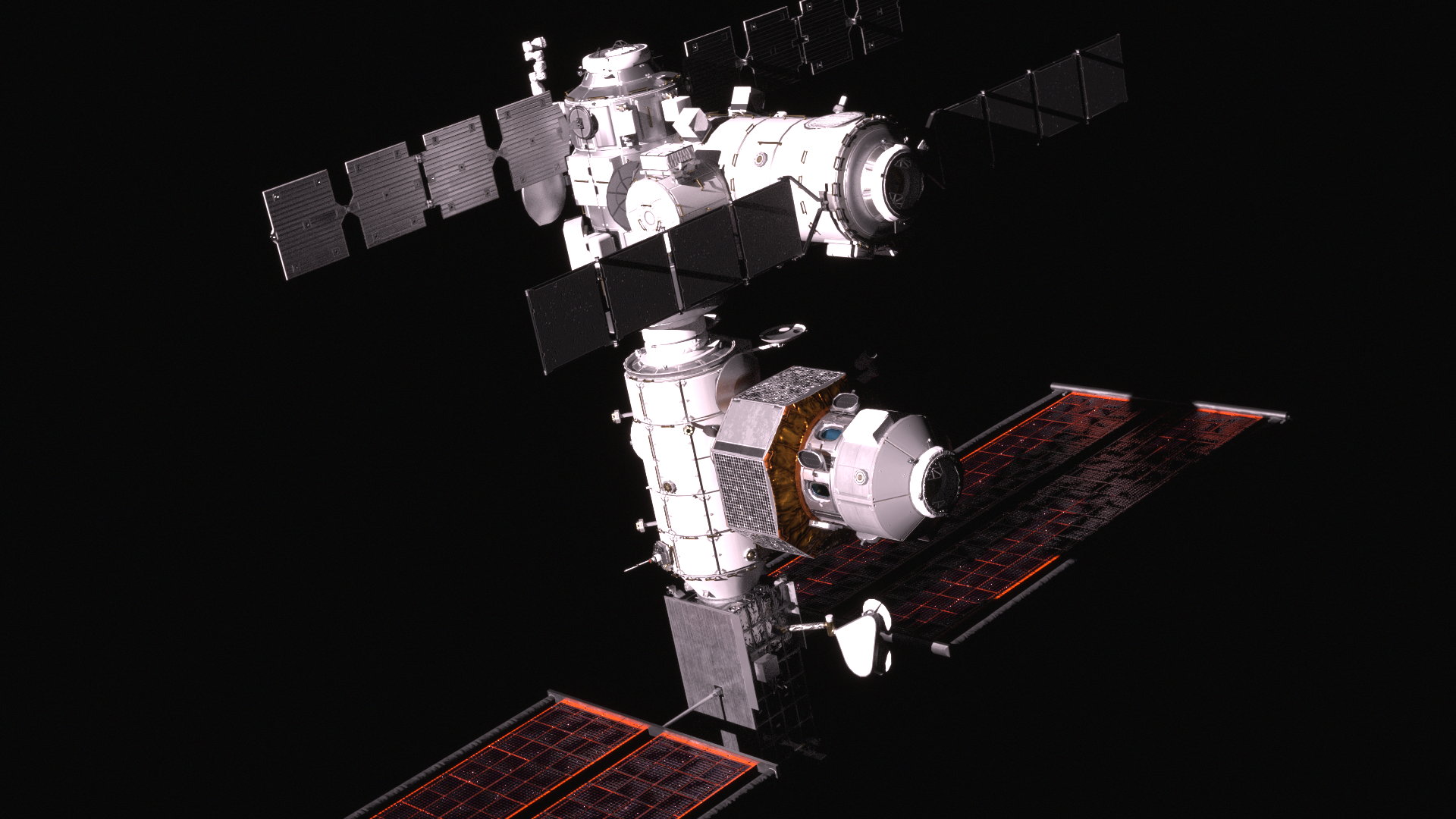
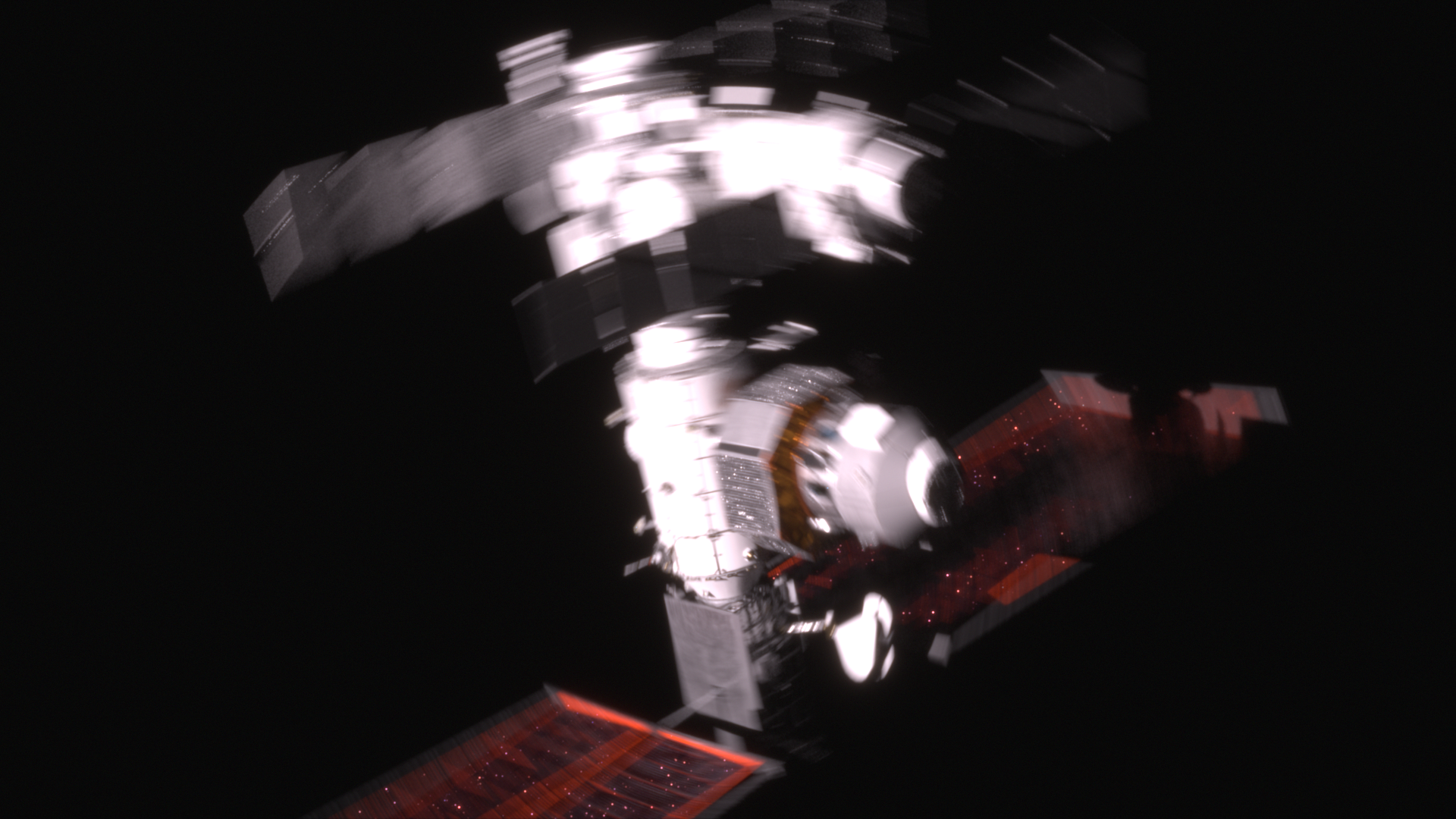
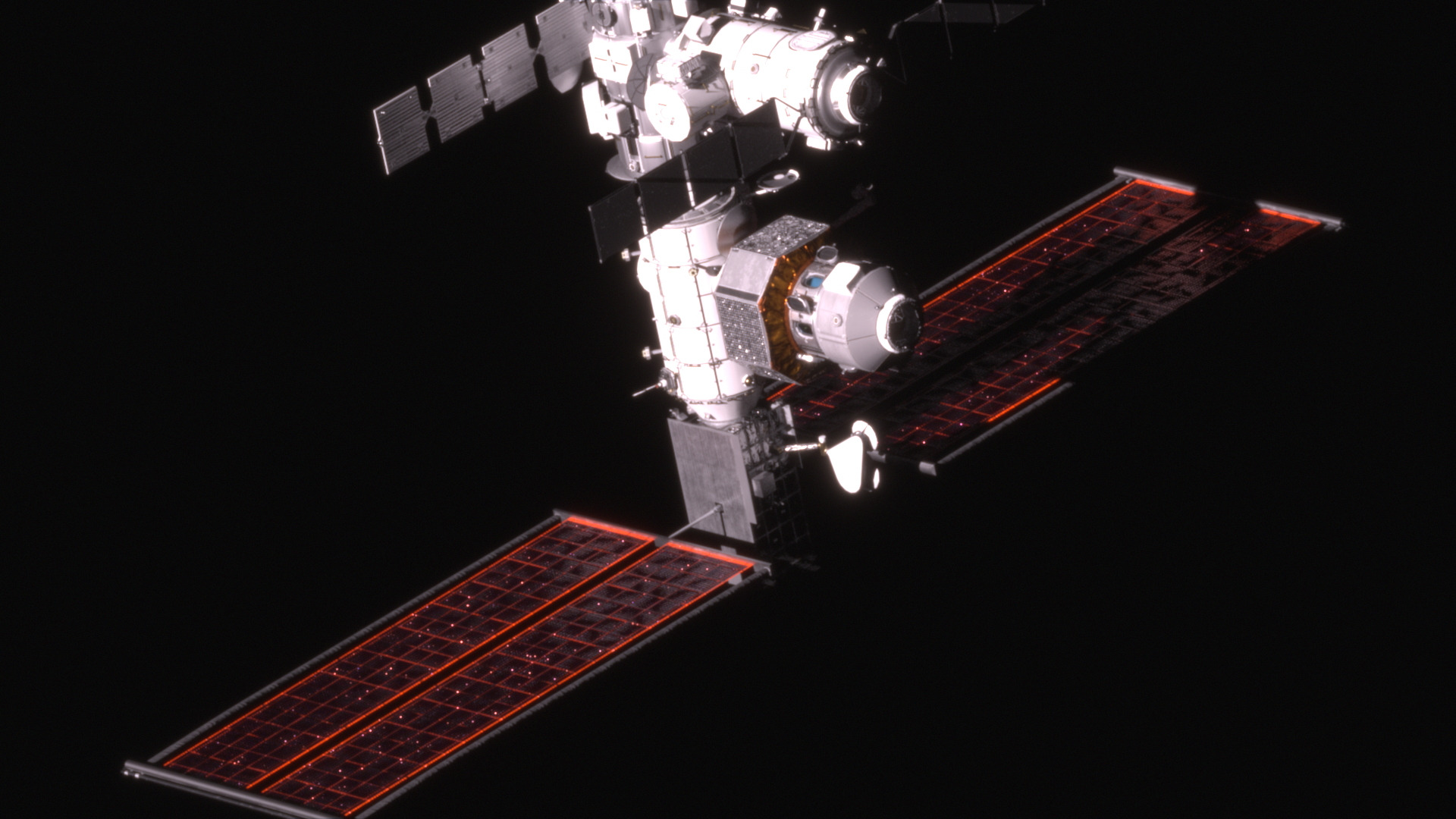
NASA’s model of the Gateway, spinning once a second. A short exposure freezes the spin; a long one smears its outer parts into arcs around the spin axis, while the parts near it stay sharp.
Short exposure (0.25 ms) |
Long exposure (16 ms) |
|---|---|
|
|
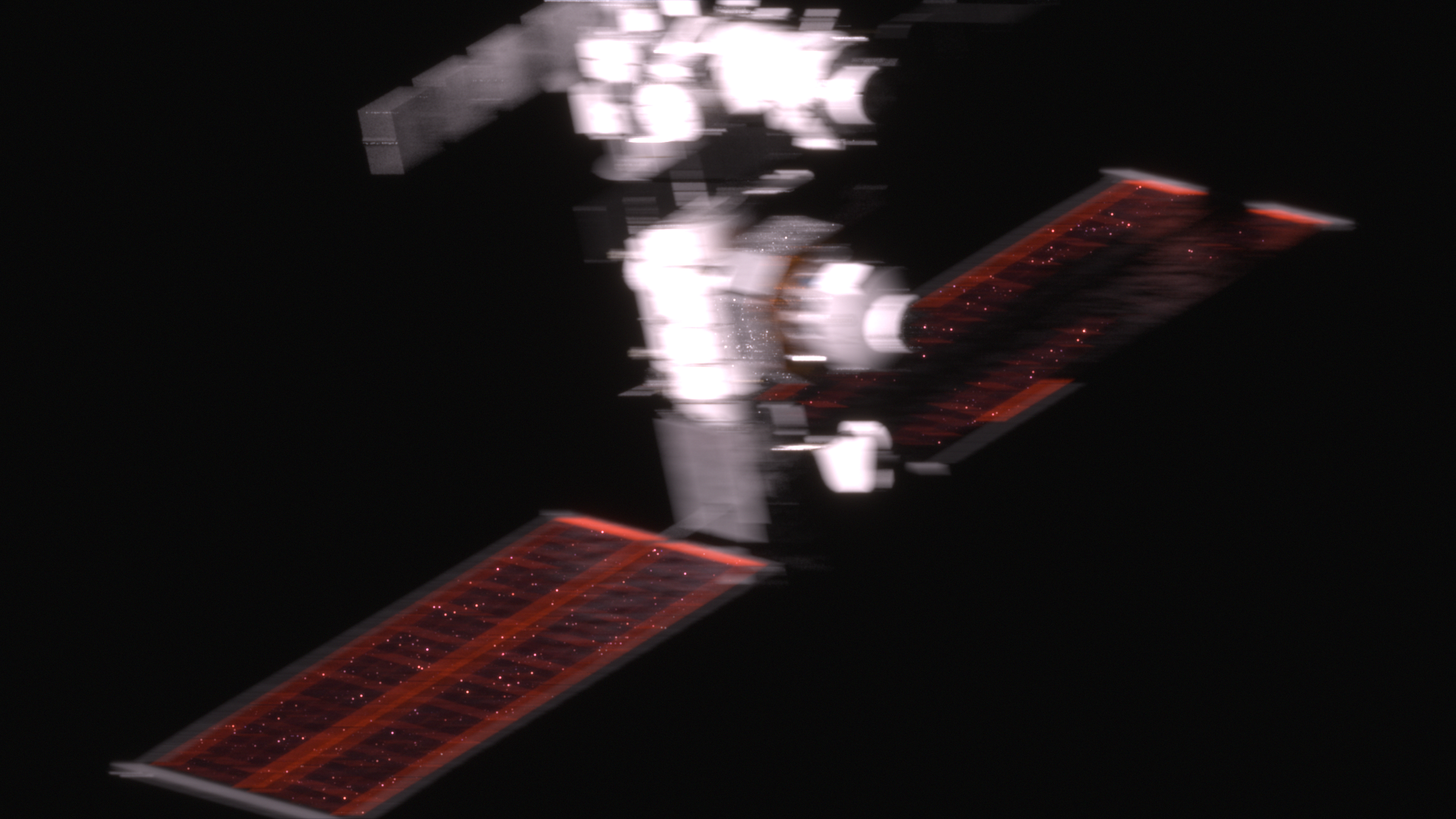
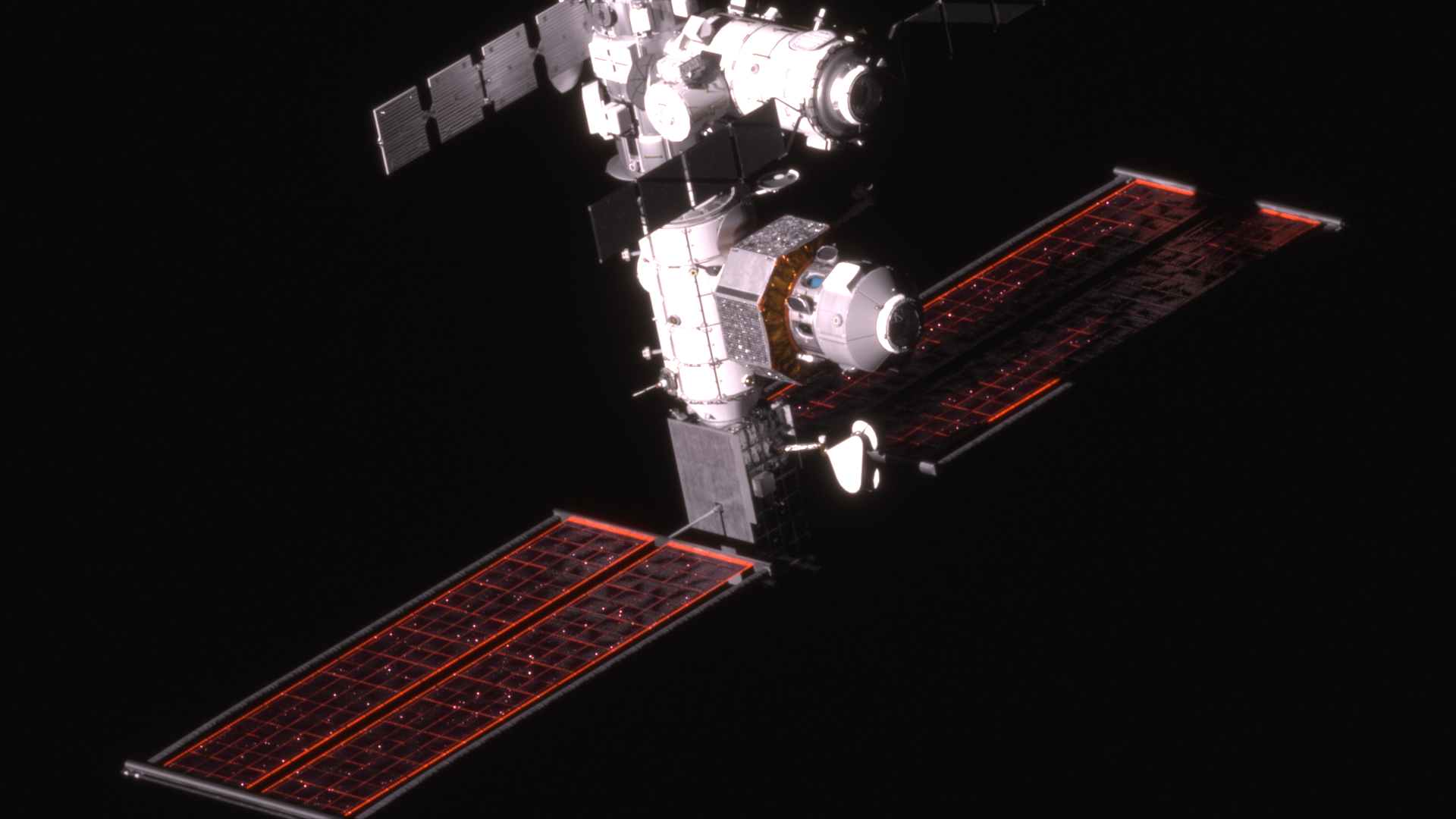
Then the Gateway passes the camera at 60 m/s. A camera that stares sees it smear along its path; one that tracks it with look_at turns to follow it, and holds it sharp. With motion blur off, the camera renders a still frame from the middle of the exposure.
Staring (16 ms) |
Tracking (16 ms) |
Motion blur off |
|---|---|---|
|
|
|
Data
File |
What it is |
From |
|---|---|---|
|
NASA’s model of the Gateway |
This is the model from 03 - Load a model: if you have it already, pass its path instead. Otherwise, download it into this folder:
curl -fLO https://media.huira.space/data/models/nasa/gateway.glb
Licenses, and how to credit the data: Gateway model.
Run
From this folder, in Python:
python motion_blur.py gateway.glb
or in C++, built as in Running the examples:
../../build/12_motion_blur gateway.glb
Each writes its images to output/, in the folder it runs from.
Source
The complete example, in both languages. View this example on GitHub.
"""
12 - Motion blur

Demonstrates:
    - Spinning an instance (set_angular_velocity) and moving it (set_velocity), so that it moves
      during the exposure
    - Exposure time against motion: a short exposure freezes it, a long one smears it, and the
      f-number keeps the image equally bright
    - Temporal samples: the times at which the SceneView places each thing in view, chosen for
      each, as many as its motion needs
    - Tracking a moving target with look_at, which turns the camera through the exposure
    - Turning a camera's motion blur off (enable_motion_blur), for a still frame

Builds on: 03 Load a model
Data: gateway.glb, NASA's model of the Gateway (see README.md)

Run:
    python motion_blur.py gateway.glb

Writes:
    output/12_motion_blur_short.png      the Gateway spinning, frozen by a 0.25 ms exposure
    output/12_motion_blur_long.png       the same spin over 16 ms: its outer parts smear into arcs
    output/12_motion_blur_passing.png    the Gateway passing a camera that stares: it smears
    output/12_motion_blur_tracking.png   ...and a camera that tracks it: it stays sharp
    output/12_motion_blur_still.png      ...and with motion blur off: a still frame
"""

import math
import sys
from pathlib import Path

import huira
from huira.rgb import Scene, SceneView, Renderer

from huira.units import Meter as m
from huira.units import Millimeter as mm
from huira.units import Degree as deg
from huira.units import AstronomicalUnit as au
from huira.units import Millisecond as ms
from huira.units import DegreesPerSecond as degps
from huira.units import MetersPerSecond as mps


def main():
    if len(sys.argv) != 2:
        sys.exit("Usage: python motion_blur.py <gateway.glb>\nREADME.md says where to get it.")
    model_path = Path(sys.argv[1])
    output_dir = Path("output")
    output_dir.mkdir(exist_ok=True)

    scene = Scene()

    # The Gateway at the origin, lit by the Sun, and the camera of example 03, 57 m away:
    gateway = scene.root.new_instance(scene.load_model(model_path, "gateway"))

    sun = scene.root.new_instance(scene.new_sun_light())
    sun.set_position(m(0), au(-1), m(0))
    scene.set_background_radiance(1e-7)

    camera_model = scene.new_camera_model()
    camera_model.use_blender_convention()
    camera_model.set_focal_length(mm(50))
    camera_model.configure_sensor_from_size((1920, 1080), mm(36))

    camera = scene.root.new_instance(camera_model)
    camera.set_position(m(40), m(-40), m(0))
    camera.set_euler_angles(deg(95), deg(0), deg(45))

    # A second camera, with a 500 mm lens, 600 m from the Gateway in the same direction, which
    # shows it as large as the first. It watches the Gateway pass, below.
    telephoto_model = scene.new_camera_model()
    telephoto_model.use_blender_convention()
    telephoto_model.set_focal_length(mm(500))
    telephoto_model.configure_sensor_from_size((1920, 1080), mm(36))

    telephoto = scene.root.new_instance(telephoto_model)
    distance = 600.0 / math.sqrt(2.0)
    telephoto.set_position(m(distance), m(-distance), m(0))

    # The path tracing settings of 03:
    renderer = Renderer()
    renderer.set_samples_per_pixel(256)
    renderer.set_max_bounces(3)
    renderer.set_indirect_clamp(10.0)
    renderer.set_dynamic_sampling(True)
    renderer.set_min_samples(16)

    time = huira.Time("2026-01-01T00:00:00")

    def render(model, viewer, duration, fstop, name):
        model.set_fstop(fstop)
        model.precompute()

        # The exposure is centered on the time: what is placed by hand is where it was put at
        # the middle of the exposure, and its velocities move it from there.
        exposure = huira.Interval.from_centered(time, duration)

        # The SceneView places each thing in view at times spread over the exposure, its
        # temporal samples, and each of a pixel's samples is traced at its own time between
        # them, so what moves blurs. It chooses them for each thing: one for what does not move
        # in view, and otherwise as many as keep it within a tenth of a pixel of where it truly
        # is (the motion tolerance, which can be given after the number of samples). A number
        # of samples can be given instead, the same for everything.
        scene_view = SceneView(scene, exposure, viewer)
        samples = scene_view.max_temporal_samples()
        print(f"{name}: up to {samples} temporal sample{'' if samples == 1 else 's'}")

        frame_buffer = model.make_frame_buffer()
        frame_buffer.enable_sensor_response()
        renderer.render(scene_view, frame_buffer)
        huira.write_png(
            output_dir / f"12_motion_blur_{name}.png",
            huira.linear_to_srgb(frame_buffer.sensor_response),
        )

    # The Gateway spins once a second (60 rpm), about the line from it toward the camera.
    # set_angular_velocity takes the rate about each of the parent's axes, here the scene's: a
    # vector along the spin axis, as long as the rate. An instance turns about its own origin,
    # so the axis runs through the model's origin. Points on it stay put, and the farther a
    # point is from it, the faster it moves.
    rate = 360.0 / math.sqrt(2.0)
    gateway.set_angular_velocity(degps(rate), degps(-rate), degps(0))

    # The light a pixel collects goes as the exposure time over the square of the f-number, so
    # each exposure below is paired with an f-number that keeps the image as bright as 03's
    # (1 ms at f/16).

    # A short exposure: 0.25 ms at f/8. The Gateway turns 0.09 degrees, and a point 10 m from the
    # axis moves 1.6 cm, under a pixel: the spin is frozen.
    render(camera_model, camera, ms(0.25), 8, "short")

    # A long exposure: 16 ms, 64 times as long, at f/64, which lets in 1/64 as much light. The
    # Gateway turns 5.8 degrees, and a point 10 m from the axis moves 1 m, about 50 pixels: the
    # parts far from the axis smear into arcs around it, while those near it stay sharp. (At
    # f/64 diffraction spreads light over a couple of pixels, as example 10 shows, which softens
    # the whole image a little: far less than the motion blurs it.)
    render(camera_model, camera, ms(16), 64, "long")

    # Now the Gateway stops spinning, and passes at 60 m/s instead, across the view of the
    # telephoto camera. Seen from nearby, the Gateway's near parts would cross the view faster
    # than its far parts; from far away, they all cross it at nearly the same rate, as one.
    gateway.set_angular_velocity(degps(0), degps(0), degps(0))
    speed = 60.0 / math.sqrt(2.0)
    gateway.set_velocity(mps(speed), mps(speed), mps(0))

    # A camera that stares at where the Gateway is at the middle of the exposure. In 16 ms, the
    # Gateway moves 0.96 m, about 43 pixels, and smears along its path. (look_at given a point
    # turns the camera to face it once; +z is up in the image.)
    up = huira.Vec3(0, 0, 1)
    telephoto.look_at(huira.Vec3(0, 0, 0), up)
    render(telephoto_model, telephoto, ms(16), 64, "passing")

    # A camera that tracks it. look_at given an instance follows it through the exposure: the
    # camera turns as the Gateway passes, keeping it at the center of the image, and it stays
    # sharp. Anything else in view, such as the stars behind it, would smear instead, as the
    # camera turned past them.
    telephoto.look_at(gateway, up)
    render(telephoto_model, telephoto, ms(16), 64, "tracking")

    # Motion blur can be turned off for a camera: a view through it then renders a still frame,
    # at the middle of the exposure, however things move (as one temporal sample does, whatever
    # number is given). It is quicker, for previews, and shows where everything is. The camera
    # stares again, and the Gateway is seen sharp, as it is midway through its pass.
    telephoto.look_at(huira.Vec3(0, 0, 0), up)
    telephoto_model.enable_motion_blur(False)
    render(telephoto_model, telephoto, ms(16), 64, "still")


if __name__ == "__main__":
    main()
// 12 - Motion blur
//
// Demonstrates:
//   - Spinning an instance (set_angular_velocity) and moving it (set_velocity), so that it moves
//     during the exposure
//   - Exposure time against motion: a short exposure freezes it, a long one smears it, and the
//     f-number keeps the image equally bright
//   - Temporal samples: the times at which the SceneView places each thing in view, chosen for
//     each, as many as its motion needs
//   - Tracking a moving target with look_at, which turns the camera through the exposure
//   - Turning a camera's motion blur off (enable_motion_blur), for a still frame
//
// Builds on: 03 Load a model
// Data: gateway.glb, NASA's model of the Gateway (see README.md)
//
// Run:
//   ./12_motion_blur gateway.glb
//
// Writes:
//   output/12_motion_blur_short.png      the Gateway spinning, frozen by a 0.25 ms exposure
//   output/12_motion_blur_long.png       the same spin over 16 ms: its outer parts smear into arcs
//   output/12_motion_blur_passing.png    the Gateway passing a camera that stares: it smears
//   output/12_motion_blur_tracking.png   ...and a camera that tracks it: it stays sharp
//   output/12_motion_blur_still.png      ...and with motion blur off: a still frame

#include <cmath>
#include <cstddef>
#include <filesystem>
#include <iostream>
#include <string>

#include "huira/huira.hpp"

namespace fs = std::filesystem;

using namespace huira::units::literals;

using TSpectral = huira::RGB;

int main(int argc, char** argv)
{
    if (argc != 2) {
        std::cerr << "Usage: 12_motion_blur <gateway.glb>\nREADME.md says where to get it.\n";
        return 1;
    }
    const fs::path model_path = argv[1];
    fs::create_directories("output");

    huira::Scene<TSpectral> scene;

    // The Gateway at the origin, lit by the Sun, and the camera of example 03, 57 m away:
    auto gateway = scene.root.new_instance(scene.load_model(model_path, "gateway"));

    auto sun = scene.root.new_instance(scene.new_sun_light());
    sun.set_position(0_m, -1_au, 0_m);
    scene.set_background_radiance(1e-7f);

    auto camera_model = scene.new_camera_model();
    camera_model.use_blender_convention();
    camera_model.set_focal_length(50_mm);
    camera_model.configure_sensor_from_size({1920, 1080}, 36_mm);

    auto camera = scene.root.new_instance(camera_model);
    camera.set_position(40_m, -40_m, 0_m);
    camera.set_euler_angles(95_deg, 0_deg, 45_deg);

    // A second camera, with a 500 mm lens, 600 m from the Gateway in the same direction, which
    // shows it as large as the first. It watches the Gateway pass, below.
    auto telephoto_model = scene.new_camera_model();
    telephoto_model.use_blender_convention();
    telephoto_model.set_focal_length(500_mm);
    telephoto_model.configure_sensor_from_size({1920, 1080}, 36_mm);

    auto telephoto = scene.root.new_instance(telephoto_model);
    const huira::units::Meter distance(600.0 / std::sqrt(2.0));
    telephoto.set_position(distance, -distance, 0_m);

    // The path tracing settings of 03:
    huira::Renderer<TSpectral> renderer;
    renderer.set_samples_per_pixel(256);
    renderer.set_max_bounces(3);
    renderer.set_indirect_clamp(10.0f);
    renderer.set_dynamic_sampling(true);
    renderer.set_min_samples(16);

    const huira::Time time("2026-01-01T00:00:00");

    auto render = [&](const huira::CameraModelHandle<TSpectral>& model,
                      const huira::InstanceHandle<TSpectral>& viewer,
                      huira::units::Second duration,
                      float fstop,
                      const std::string& name) {
        model.set_fstop(fstop);
        model.precompute();

        // The exposure is centered on the time: what is placed by hand is where it was put at
        // the middle of the exposure, and its velocities move it from there.
        const huira::Interval exposure = huira::Interval::from_centered(time, duration);

        // The SceneView places each thing in view at times spread over the exposure, its
        // temporal samples, and each of a pixel's samples is traced at its own time between
        // them, so what moves blurs. It chooses them for each thing: one for what does not move
        // in view, and otherwise as many as keep it within a tenth of a pixel of where it truly
        // is (the motion tolerance, which can be given after the number of samples). A number
        // of samples can be given instead, the same for everything.
        huira::SceneView<TSpectral> scene_view(scene, exposure, viewer);
        const std::size_t samples = scene_view.max_temporal_samples();
        std::cout << name << ": up to " << samples << " temporal sample"
                  << (samples == 1 ? "" : "s") << "\n";

        auto frame_buffer = model.make_frame_buffer();
        frame_buffer.enable_sensor_response();
        renderer.render(scene_view, frame_buffer);
        huira::write_image_png(fs::path("output") / ("12_motion_blur_" + name + ".png"),
                               huira::linear_to_srgb(frame_buffer.sensor_response()));
    };

    // The Gateway spins once a second (60 rpm), about the line from it toward the camera.
    // set_angular_velocity takes the rate about each of the parent's axes, here the scene's: a
    // vector along the spin axis, as long as the rate. An instance turns about its own origin,
    // so the axis runs through the model's origin. Points on it stay put, and the farther a
    // point is from it, the faster it moves.
    const huira::units::DegreesPerSecond rate(360.0 / std::sqrt(2.0));
    gateway.set_angular_velocity(rate, -rate, 0_degps);

    // The light a pixel collects goes as the exposure time over the square of the f-number, so
    // each exposure below is paired with an f-number that keeps the image as bright as 03's
    // (1 ms at f/16).

    // A short exposure: 0.25 ms at f/8. The Gateway turns 0.09 degrees, and a point 10 m from the
    // axis moves 1.6 cm, under a pixel: the spin is frozen.
    render(camera_model, camera, 0.25_ms, 8.f, "short");

    // A long exposure: 16 ms, 64 times as long, at f/64, which lets in 1/64 as much light. The
    // Gateway turns 5.8 degrees, and a point 10 m from the axis moves 1 m, about 50 pixels: the
    // parts far from the axis smear into arcs around it, while those near it stay sharp. (At
    // f/64 diffraction spreads light over a couple of pixels, as example 10 shows, which softens
    // the whole image a little: far less than the motion blurs it.)
    render(camera_model, camera, 16_ms, 64.f, "long");

    // Now the Gateway stops spinning, and passes at 60 m/s instead, across the view of the
    // telephoto camera. Seen from nearby, the Gateway's near parts would cross the view faster
    // than its far parts; from far away, they all cross it at nearly the same rate, as one.
    gateway.set_angular_velocity(0_degps, 0_degps, 0_degps);
    const huira::units::MetersPerSecond speed(60.0 / std::sqrt(2.0));
    gateway.set_velocity(speed, speed, 0_mps);

    // A camera that stares at where the Gateway is at the middle of the exposure. In 16 ms, the
    // Gateway moves 0.96 m, about 43 pixels, and smears along its path. (look_at given a point
    // turns the camera to face it once; +z is up in the image.)
    const huira::Vec3<double> up{0.0, 0.0, 1.0};
    telephoto.look_at(huira::Vec3<double>{0.0, 0.0, 0.0}, up);
    render(telephoto_model, telephoto, 16_ms, 64.f, "passing");

    // A camera that tracks it. look_at given an instance follows it through the exposure: the
    // camera turns as the Gateway passes, keeping it at the center of the image, and it stays
    // sharp. Anything else in view, such as the stars behind it, would smear instead, as the
    // camera turned past them.
    telephoto.look_at(gateway, up);
    render(telephoto_model, telephoto, 16_ms, 64.f, "tracking");

    // Motion blur can be turned off for a camera: a view through it then renders a still frame,
    // at the middle of the exposure, however things move (as one temporal sample does, whatever
    // number is given). It is quicker, for previews, and shows where everything is. The camera
    // stares again, and the Gateway is seen sharp, as it is midway through its pass.
    telephoto.look_at(huira::Vec3<double>{0.0, 0.0, 0.0}, up);
    telephoto_model.enable_motion_blur(false);
    render(telephoto_model, telephoto, 16_ms, 64.f, "still");
}